Tuesday, March 31, 2020

Creative connections

It's still early in this time of Covid-19, and things will get worse before they get better. But I have to say that, so far, I'm really impressed with the many creative ways that people are coping with this crisis. Besides being invited to socially-distanced walks with neighbours, I've been on the receiving end of several other fun initiatives to keep spirits up... mostly online: games of Trivial Pursuit and dice (I won 40 cents that will never be collected!), a yoga class, meditative evening prayer from Taizé, and a wine and cheese phone call with a high school chum.

But the most amazing thing so far was a re-connection with a large group of friends, many of whom I haven't seen in over 30 years. I traveled for a year as as a student member of an Up With People cast of 130+ people in a musical, educational and cultural program which focused on peace, love and friendship among nations. We performed in the U.S., Canada, and more than a half-dozen countries in Europe, while participating in community involvement activities at schools, senior centres, and social agencies. Living with a large group like that, I made a few lifelong friends, but keeping up with everyone was impossible. Back in the 80's, all we had was snail mail, and long distance phone calls were pricey, especially overseas!

But communication now is another story altogether. On Saturday morning, my friend Allie, who subscribes to an online conferencing service, invited as many castmates as she could to join her in an online video gathering. By the end of the meeting, 2 screens worth of about 40 friends from 7 different countries connected (some for over 4 hours). Everyone agreed that it was pretty great to see people we hadn't seen since we did our final show at the Capitol Building in Washington D.C. on July 4, 1988.

At first, our online gathering was chaos, everyone trying to get a word in edgewise, but then Andrew decided we should all take turns updating each other about our lives, and that worked really well. Our lives have taken many twists and turns, and it seems we're all in different stages of self-isolation because of the corona virus, but are finding all sorts of different ways to stay connected with the people we love.

If the human race learns anything from this pandemic, I hope it's a deeper appreciation of the things we've been taking for granted, and that who we are and how we love one another is what's most important.

Here's a beautiful little video about how one poet sees that the coronavirus is helping us to reframe our lives... Thanks, Nora, for sharing it with me! Be well, all...


Sunday, March 29, 2020

Sunday reflection: From non-necessities to needful things

This Sunday reflection is brought to you by
Ezekiel 37:12-14.

You open our graves,
O God,
though we don't realize
the many ways we have died.

You bring us up from our graves,
and we begin to see
how we have exiled ourselves
from the good you want
for us.

Suddenly
we begin to understand
how we have chosen
other spirits to lead us
instead of your Spirit
within us.

Our lives have been filled
with non-necessities:
self-importance,
busy work so that we can impress others
by our useful lifestyles,
needless activities and possessions,
and many other things
that ultimately do not matter.

But you choose this time
to put your Spirit within us
and to ground us
in the needful things:
compassion,
connection
(from the appropriate social distance)
and appreciation of basic necessities and
all that we have received from you.

You promise that
your Spirit
gives us life,
and that even in this time of struggle
you speak and act
through our love for each other.

Stay with us,
O God,
and keep us grounded
in you.

+Amen

* * * * * * *

I love how on this Lazarus Sunday, the fifth Sunday of Lent, we are told the story of Jesus' interactions with his three friends from Bethany at a time when they are in crisis... how he grieves with Mary and Martha, and turns their sorrow to joy by returning their brother to them.

In this time of Covid-19, we may be feeling like so much of what we have known and loved has been laid in a tomb, but we are called to keep the faith that resurrection will come. We are to continue to support each other in whatever ways we can (don't forget your local farmer's markets and other small businesses), and to share our resources with those who are coming up short (also remember our charities who are helping many in need). 

In spite of all the uncertainties we are facing, I can't help but feel that with this opportunity to re-prioritize our lives, moving from the non-necessities to the needful things, we are learning to live as God has wanted us to live all along, in a greater communion with each other and all of creation.

* * * * * * *

I'm taking a bit of a break from Laudato Si Sunday reflections for the time being, but encourage anyone who has some time to read through it and come to an understanding of the kind of world we might create when we emerge on the other side of this pandemic. Past Laudato Si reflections can be found here, and the Encyclical itself can be found here. Happy reading!


Friday, March 27, 2020

Letting go of fear, choosing change

If you're not living with a sense of unease in these days of the corona virus, I suspect you're more the exception than the rule. I'm already tired of the word "unprecedented" and all the other words like it.

While it's true that our current generations have never been though anything like this pandemic, it's also important to remember that there have always been people around the globe and even in our own neighbourhoods who have lived with forms of uncertainty and fear that we have never known.

But suddenly, we are all in the same boat with Covid-19, which doesn't respect the nice little boxes into which we have placed ourselves. No matter who we are, our lives have changed and are changing because of this epidemic, and it seems that those of us who have lived in relatively secure comfort all our lives are most discomfited by all these things that are suddenly beyond our control.

The virus is frightening enough. It's killing people. What it means for our future is also frightening, because we know that nothing will be the same.

But rather than be engulfed by fear, and its companions, greed and suspicion, I prefer to look at this time as a God-given opportunity to think about the kind of world we want to inhabit once we live beyond the virus. This is a moment when we may have an opportunity to "RESET" our future. And here are some questions I've been asking myself about it all:

During and after Covid-19, can we better care for those who have always been marginalized?

During and after Covid-19, can we choose interdependence over individualism?

During and after Covid-19, can we better care for all of creation?

During and after Covid-19, can we value every person as an equal?

During and after Covid-19, can we re-evaluate and put less emphasis on money and economic growth?

During and after Covid-19, can we put truth and reconciliation to work and re-build stronger relationships with our Original Peoples?

During and after Covid-19, can we choose to live with just enough?

During and after Covid-19, can we re-develop our society into one where everyone works as best they can and everyone is provided a universal basic income that provides for their needs?

During and after Covid-19, can we rebuild our education, healthcare, justice, and social systems so no one falls through the cracks?

During and after Covid-19, can we become more cooperative and less competitive?

During and after Covid-19, can we forgo past teachings about what’s important and replace them with what we are discovering to be truly important?

During and after Covid-19, can we cut climate change, pollution, and environmental degradation by simplifying our lifestyles, living with less and Being more?

During and after Covid-19, can we hold onto the lessons we are learning about community, generosity, togetherness, friendship, love, laughter, nature, and all the things we take for granted, but especially our health?

As I ask myself these questions, I see some of this work already beginning. Many of our politicians have set aside their differences and ideologies to do what's best for the common good. I cheer them on, and will probably write them a few letters of encouragement with suggestions for our collective future.

We still have a long way to go to get through this epidemic, and many heartbreaks and struggles to come, but rather than living in fear, let's imagine the world we really want and move forward with it foremost in our minds.

It's time to let go of our fear and choose the change we want to see in our world.

Sunday, March 22, 2020

Laudato Si Sunday reflection: Protecting what we hold in common

This week's reflection is brought to you by
Ephesians 5:8-14.

You call us,
O God,
to live as your children,
children of light.

Our light --
our goodness and truth --
needs to shine for the world to see,
especially in these darker than usual days.

If we do what is pleasing to you,
avoid darkness
and bring everything into your light,
that light will drive out darkness.

You call us to awake
from the sleep of unconcern for others,
to rise from darkness and death
and you shine on us!

Help us to reach out
with your love and light
as we are able.

Let us do your will
and share your joy
even as we do all we can to
"flatten the curve."

Remind us often
that we are all in this together,
that we hold our health in common
at this time.

May our smiles
rather than our anxieties
shine
for all those
who need reassurance.

Be with us,
O God.

+Amen

* * * * * * *

I'm finding it challenging to connect our little encyclical study with this world pandemic that has suddenly arrived almost everywhere. But I think that this week's piece of Laudato Si: On Care for Our Common Home connects with things we need to do to protect our 'global commons' -- which is our earth's global health in the face of Covid-19 and climate change. We're looking at paragraphs 173 to 177, which can be accessed by clicking here and scrolling down.

I'd like to begin by highlighting most of paragraph 173, where Pope Francis and the encyclical team say
Enforceable international agreements are urgently needed, since local authorities are not always capable of effective intervention. Relations between states must be respectful of each other's sovereignty, but must also lay down mutually agreed means of averting regional disasters which would eventually affect everyone. Global regulatory norms are needed to impose obligations and prevent unacceptable actions...
These words are referring to caring for the environment, but if there is any good news to be had right now, it seems that many (though not all) world leaders are taking this pandemic seriously and implementing necessary restrictions to slow the virus' spread. I am hopeful that, once we get through this health crisis, our leaders will have learned something about how to work together as a world community to implement necessary restrictions on things that harm Mother Earth. Perhaps our politicians will come to understand that the economy isn't the only bottom line of which we must take care. Our environments and all its living beings must become the priority! Pray with me for that awareness in leaders who are willing to stand for necessary changes to the way the dollar has been more important than creation!

In paragraph 174 Pope Francis makes note of the fact that international and regional conventions on ocean governance come up short due to "fragmentation and the lack of strict mechanisms of regulation, control and penalization..." He can't be more right when he says at the end of paragraph 174 that "What is needed, in effect, is an agreement on systems of governance for the whole range of so-called "global commons."

At the moment, we are learning from one another about ways to effectively reduce the rates of Corona Virus infection. Many scientists and healthcare professionals from around the globe are working together toward something that is necessary for the health we hold in common. Just imagine if we could use similar methods to involve the entire planet in caring for our common home!

In paragraph 175, we hear that we need to make more radical decisions about reducing pollution and eliminating poverty. It seems we human beings are stuck in a rut when it comes to handling our problems, the Pope says, because "the economic and financial sectors, being transnational, tends to prevail over the political."

As I watch our economic and financial sectors fluctuate and tumble, as I see our political leaders offer financial supports to those who are suddenly unemployed and unable to make ends meet because of job losses or health issues, and as I watch neighbours reaching out to neighbours, I can't help but hope that this global economic shake-up will be the wake up call our world needs to help it regain equilibrium for the sake of all creation, that people will understand that true wealth only exists when ALL BEINGS are well together.

So maybe it's time to think outside our previous boxes, "to devise stronger and more efficiently organized international institutions" with leaders who work together for justice, peace, and equity for all (paragraph 175). If you had to come up with "a true world political authority" (Pope Francis is quoting his predecessor, Pope Benedict, at the end of paragraph 175), how would you do it? Wouldn't it be great to have a wise world governing body that can look after humanity as a whole in times of crisis, work for disarmament and peace, ensure an end to poverty, disease and hunger, and protect the web of life that we call creation?

I sure don't know how to create a world governing body that will make a difference, but I'd like to nominate people like our female chief medical officers, who are offering wisdom and calm in this very difficult time. Drs. Deena Hinshaw, Bonnie Henry and Theresa Tam have been amazing in all their efforts. If we can support organizations that dream and brainstorm and train similar wise and calm leaders who can tell it like it is and inspire us to take these difficult steps like these women have in order to "flatten the curve" of the Corona virus, perhaps we could one day have similar leaders to save our 'global commons.'

But we need to start looking for these leaders now, and supporting their environmental efforts. If you find yourself with time on your hands this week, I'd encourage you to do a bit of research into environmental leaders and organizations that are making a difference for the sake of Mother Earth. And if there's a way for you to support their growth, even with just a note of appreciation for their efforts, go for it!

We hold so many things in common -- air, earth, water, our health and the health of this beautiful sphere we call home. Every one of us can do something to leave our home better than we find it right now. We arise from the sleep of unawareness of all those with whom we share our earth, and begin to shine God's light around us. Even just by offering a smile (though I challenge us all to do more than that)!

Wednesday, March 18, 2020

There's suddenly more time to pray

I had great intentions at the beginning of this Lent to double my meditation time. For the past year or so, I've been doing my best to spend 20 minutes every morning in contemplative prayer. For me, that means sitting, usually with dog close by and a cup of tea, lifting people in my life up to God one by one, and then just resting in God's presence. Of course, my monkey mind runs all over the place, but the point of contemplation is to come to an awareness of my thoughts, and turn them back to God.

Sometimes I sit for twenty minutes and never get back to God more than once or twice! But God knows I'm trying -- at least I've set aside the time.

My hope for this Lent, which began three weeks ago, was to add a 20-minute evening meditation. Which didn't happen -- until this week. Since Monday, I've been lighting a candle and sitting at about 9 pm, and my monkey mind seems to be a little less frenetic later in the day.

Of course, the big motivation for finally meeting my Lenten resolution is our current pandemic, and all the anxiety that the world seems to be feeling right now, come home in my own psyche. If we've ever needed contemplation and calm, now is the time. So I'm suddenly making more time to pray.

And then the Taizé Community ups the ante! This week, the Community closed its doors and sent all pilgrims and volunteers home (and maybe some brothers, too). But always concerned about hospitality, it has invited us all into its evening prayer through online streaming via Facebook. 8:30 pm prayer in France occurs at 1:30 pm here (MST). The first two days, I was doing other things at 1:30, but the prayer was recorded and can be viewed as soon as it concludes.

Still, I love the idea that there are many of us around the world who are able to join with the men in that little room on a hill in the Burgundy region of France. 3.4 thousand of us joined today's evening prayer from all over the globe, and personally, I delighted in singing the alto (for the chants I knew) with the brothers, who supply the melody, tenor and bass lines. It's international ecumenical prayer without any of us having to burn fossil fuels to participate.

Knowing that I am praying with people from Adelaide, Belfast, Istanbul, Jakarta, Modena, Posnan, Seoul, Turku -- the list goes on -- somehow makes the prayer feel deeper, all our voices calling together to God from across the planet.

It feels right. And I don't doubt that God is listening.

If you would like to join us tomorrow at 1:30, or later tonight for a replay, here's a link to the Facebook page: https://www.facebook.com/taize/.

Saturday, March 14, 2020

Sunday reflection: A prayer for the common good

Today's reflection is brought to you by
Romans 5:1-8.

You are our peace,
O God.

Your grace is our hope.

Even in our sufferings,
hope in you will
teach us to endure,
to become who we are meant to be,
to live toward your glory
for the sake of all your creation.

Our weakness has been strengthened in you,
because you have poured your abundant love
over us and all your creation.

That is the reason for our hope!

Remind us
in this time of crisis
that we are to act in the best interests
of our world community,
in the best interests of all that you have made.

Protect us from anxiety
and lead us to generosity.

Bless those
whose health and energies are most severely affected
by this pandemic,
and especially,
those who care for them.

May our prayer and care
fill them with your hope and strength!

Make us mindful of the good of all beings
as we move ahead,
aware that we are deeply connected
to all that you have made.

Help us to share your abundance,
your hope,
and to love one another
in all that we do.

+Amen

* * * * * * *

This has been a challenging week as we've gone from life as we always knew it to "a new normal," in the words of our local Chief Medical Officer of Health. It's a new normal that fits with a lot of our voluntary Lenten practices --  except now we are involuntarily giving up many sources of entertainment -- sports, theatre, dining out, community recreation, etc.

The list of closures and cancellations for local events and venues is growing daily, and we find ourselves using words like "social distancing" and "self-isolation." Our lives are being pared down more severely than we would choose. But rather than take these things as deprivation, why not translate them into personal "retreat"?

These changes are necessary in order to "flatten the curve" that is this pandemic known as COVID-19 so that we can cope with an illness that threatens us all in the weeks and months ahead. We don't want to overwhelm our healthcare systems by all getting sick at the same time.

I won't deny the fact that changes like these produce anxiety -- change at any time is a challenge. But I'm trying to see what's happening as a wake-up call for our human race, an opportunity to step back from the hectic, high-stress societies we have created, and to recognize that it's not our jobs or our possessions that give us value, but who we are and how we care for one another. I'm thinking especially of the people in Sicily, singing together from their balconies. I think they have the right idea.

If there is a silver lining to all this, it might be that in stepping back, we will find better ways to care for the common good of all creation. We can learn to be more generous, to seek out those in need and offer assistance in many different ways. Mainly, being a source of calm and care.

So I'm not writing about Laudato Si: On Care for Our Common Home this weekend. Instead, I'm thinking and praying about this pandemic, and recalling the last few lines of St. Francis' Canticle of Creation, from which Pope Francis took his encyclical's title. These lines remind us of our mortality and call us to patience and peace, just as this pandemic does. These are Francis' words:

Praised be You,
my Lord,
through those who give pardon for your love
and bear infirmity and tribulation.

Blessed are those who endure in peace
for by you,
Most High,
they shall be crowned.

Praised be You, 
my Lord,
through our Sister Bodily Death
from whom no one can escape....

Blessed are those 
whom death will find 
in your most holy will,
for the second death 
will do them no harm.

I praise and bless my Lord
and give you thanks
and serve you with great humility.


For all those who will not make it through this pandemic, for all leaders and caregivers, and for all of us, that we remain in God's peace and grace and hope!

+Amen.


Things to believe in...

My best friend sent me this gorgeous tune this morning, sung by the Northern Lights Chorale from Minnesota. Her church choir will sing it tomorrow. Enjoy!


Friday, March 13, 2020

Love in the time of COVID-19

In the five minutes it took me to put on my uniform for my ushering position at the Winspear yesterday afternoon, everything changed. Once dressed, I learned that Alberta Health Services announced that all gatherings of over 250 people were banned, effective immediately. As I put my uniform back on its hanger, I could hear a couple of younger staff who seemed quite panicked, saying, "How are we supposed to live through this? This is something completely new!"

I affirmed that yes, this is an unprecedented situation that we are living through, and that all we can do is take care of each other and keep our chins up.

The challenge in this time, as I see it, is to think beyond ourselves and to unite for the common good. Yes, let's listen to our health officials when they ask us to take measures to protect the vulnerable and ourselves, but let's also remember that we are all in this together, and that hoarding needed commodities doesn't help anyone else, while snapping at each other in our anxiety only adds to the feeling of panic. Kindness is much more helpful!

It's hard to know what's coming, but at times like these, a smile goes further than anything else to bring a sense of normalcy and calm to those who really need it, and to ourselves. In this time of COVID-19, as we live through the challenges that come with a pandemic, we need to turn away from "everyone-for-themselves" thinking, listen to wise leaders, avoid gatherings, care for our neighbours, and hold onto the wisdom of the ages. It isn't easy, and it will get worse before it gets better, but if we operate from a place of positive thinking as much as possible, we have a much better chance of overcoming the struggles ahead.

The wisdom of the ages that I'm holding in my heart comes in two phrases:

Love one another. - Jesus Christ.

All shall be well, and all shall be well, and all manner of thing shall be well. - Julian of Norwich

What wisdom of the ages are you holding close these days? Please share, as what you have to offer may be exactly what someone else needs to hear.

Sunday, March 8, 2020

Laudato Si Sunday reflection: Adding to the grace of God's creation


This week's reflection is brought to you by
2 Timothy 1: 8b-10

O Christ,
you call us to join together with you
in suffering for the Gospel,
which translates to
love.

You showed us what real love is
by uniting with us
in our humanity
and teaching us
to serve one another.

Your grace is enough for us.

Let us be your grace
in all that we say,
do,
and are.

And let the grace of your creation
be foremost in our minds
in all that we say,
do,
and are,
so that we may care for it
and for each other
as you do.

+Amen

* * * * * * *

This week's section of Pope Francis' encyclical, Laudato Si: On Care for Our Common Home reminds us that humanity is capable of working together to change the course of history when it comes to caring for our planet. We're looking at paragraphs 168 to 172, which you can access by clicking here and scrolling down. Paragraph 168 carries an important message about positive experiences where different conventions made good decisions for the sake of life on earth: the Basel Convention on Hazardous Wastes, the Convention on international trade in endangered species, and the Vienna Convention for the protection of the ozone layer, which led to the Montreal Protocol which eliminated the CFCs which were creating the ozone hole.

When the ozone hole was discovered, it was a serious problem for the entire planet. And global climate change is the same sort of problem -- there is nothing on earth that isn't affected by weather which causes droughts and fires, floods and disasters. Edmonton had a tornado in 1987. Calgary had the flood of 2013. And for most of us in Alberta, these were fairly minor events. But for people living in developing countries, fires, floods, typhoons and drought cause more deaths and destruction than we can imagine, because the people in the developing world don't possess the resources we have to deal with such disasters.

"With regard to climate change, advances have been regrettably few," says the Pope in Laudato Si, his letter to the entire world. "Reducing greenhouse gases requires honesty, courage and responsibility, above all on the parts of those countries which are more powerful and pollute the most" (paragraph 169). That would be most of the countries in the western world, including us. I wish the Pope had also used the word, sacrifice, because I believe that it's getting to the point where we might have to be willing to give certain things up for the health of our planet.

Unfortunately, our political leaders prefer to point fingers at other countries, poorer than ours, who aren't doing their share to protect the environment. So we in Canada have wasted valuable time, and aren't doing enough to stop climate change as of yet. But the Pope reminds us:
there is a need for common and differentiated responsibilities. As the bishops of Bolivia have stated, "the countries which have benefited from a high degree of industrialization, at the cost of enormous emissions of greenhouse gases, have a greater responsibility for providing a solution to the problems they have caused." (Quote from the Bolivian Bishops' Conference Pastoral Letter on the Environment and Human Development in Bolivia, El universo, don de Dios para la vida from March 2012 (86).)
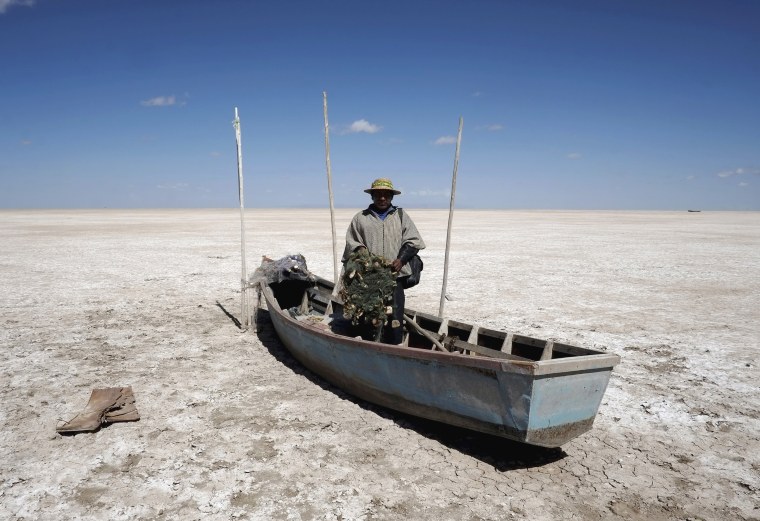
Image: Fisherman Rene Valero, from the Urus ethnic group, is seen on his boat on the dried Poopo lakebed in the Oruro Department, south of La Paz, BoliviaThose Bolivian Bishops have a lot to say when it comes to the environment, and Bolivia has been a leading country in fighting for the rights of Mother Earth. Bolivia is feeling the effects of climate change more than we are thus far. One of my kids visited the country and saw the huge mountain lake called Poopo that disappeared in 2015 due to water diversion and disappearing glaciers related to climate change. The lake will probably not replenish itself.

I was happy to see that the Pope and his encyclical writing team addressed the issue of "carbon credits" in paragraph 171. It has never made sense to me that countries could pay a certain amount of money to "remove" so many tonnes of carbon dioxide from the atmosphere -- after the fact. If I fly to Tahiti and buy a carbon offset so that I can feel better about "dealing with" the greenhouse gas emissions caused by my tropical vacation, someone might plant a tree somewhere with that offset money, but it will take years for that tree to actually remove my emissions. It would be better not to fly at all... and maybe I need to be more serious about how I'm creating greenhouse gases from the beginning. That sacrifice I was talking about earlier.

Unfortunately, so far no one seems to be willing to sacrifice jet setting vacations. While I applaud people who do what they can to offset their air travel -- I'm not saying that carbon offsets are bad -- we also need to reconsider frivolous things like flying to warm places in the winter. And our big, polluting corporations need to stop polluting instead of buying carbon credits from developing countries that don't produce large amounts of greenhouse gases. The idea is to reduce our greenhouse gases and improve the health of our atmosphere, not just to maintain things at the present level of pollution!

Paragraph 172 references the difficulties faced by poor countries and the help they will need from wealthier nations to develop less polluting forms of energy production. It also contains the encyclical's first mention of solar energy as a solution, noting that
Taking advantage of abundant solar energy will require the establishment of mechanisms and subsidies which allow developing countries access to technology transfer, technical assistance and financial resources, but in a way which respects their concrete situations, since the compatibility of [infrastructures] with the context for which they have been designed is not always adequately assessed (Pontifical Council for Justice and Peace, Energy, Justice and Peace, IV, 1, Vatican City (2014), 53.)
I am underlining and bolding the statement that follows the above comment: "The costs of this would be low, compared to the risks of climate change."

It seems to me that, here in North America, we are too afraid to change, to take on our greater responsibility as people who live in countries that contribute the most to climate change. We think it will be too expensive, or too difficult, but in reality, climate change will be more expensive, and more deadly.

We're especially concerned about our livelihoods here in Alberta, where fossil fuel extraction and related industries have been our main employer for fifty years. But if we really think about it, fossil fuels are a dead end because our great-great-grandchildren can't live on a planet choked with greenhouse gases and terrorized by catastrophic events caused by an unstable climate.

We need to change now.

This makes me think of a young man who used to work in the Oil Sands near Fort McMurray. Paul saw that the future for highly polluting chemical processes to extract bitumen from the sand, water and clay up north was taking our environment downhill, fast. So he pulled the plug on that career and retrained to install solar panels. Rather than adding to climate change through his livelihood, he's participating in less polluting work in the alternate energy field and improving the earth's health, long term.

And more of us need to think this way. How can we change and find better ways to deal with the pollution created by our lives? How can we reduce waste? How can we save energy? How can we in North America, who have created greater greenhouse gas emissions with our larger homes, multiple vehicles, and excessive possessions, shoulder our greater responsibility for providing a solution to the problems our lifestyles have caused the planet?

What is one right thing we can do in the week ahead? Or one change we can make? Can we add to the grace of God's creation?

We found a way to help the ozone layer. Now we need to live in grace with the rest of our beautiful planet.

Wednesday, March 4, 2020

Adventures in accessibility

On Monday, our L'Arche Day Program core members had a lovely afternoon at their very own art display at the Grant MacEwan University Library. Colleen, an art therapy student at the college, booked a sunny "collaboration room" and we all gathered for coffee and timbits and an opportunity to see the display and art book she had made from art created by our core members. We enjoyed time with Colleen in her university setting, and took many pictures of our group at their display.

Touchless Sensor Exit Button With LEDGrant MacEwan is the new campus in town, and I had never been up to the second floor. I was quite impressed with Barry Johns' architecture, and the accessibility of everything. Our members with wheelchairs were able to go places almost as fast as those of us on our feet thanks to plenty of elevators and those push button accessibility doors. But it was the touchless washrooms that really fascinated me, especially when Glen* decided to try one out.

Glen and I walked and wheeled past a lot of quiet students to where a sign announced an All Gender Washroom. I had already made a trip there with Sandy*, so was able to explain to Glen to wave his hand in front of a sensor that opened the door, and that when he got inside, he would have to wave his hand in front of another sensor to lock the door.

What I didn't notice was that there were two different sensors inside. As I didn't use the second sensor, I can't recall what it was for, but after the door closed behind Glen, I heard the second sensor beep as Glen waved at it. It clearly wasn't the one that locked the door, though, as the outside sensor light stayed green instead of turning red.

But Glen didn't know that, and I didn't want to disturb the students by yelling at him through the door. I figured we wouldn't be long, so I stood against the door in case someone else would come to use the washroom. Sure enough, a few minutes later, a student came and said, "Excuse me, but I'd like to use the washroom."

"Someone is in there," I told him, and he said, "but the lock light is still green." "I know," I said, "but I think my friend doesn't know that." The student giggled, and waited with me for the washroom to become available.

After the toilet flushed, I heard a faint sound of water running, followed by the clacking of the automatic towel dispenser. Then I heard Glen trying to get the door to open again.

"BEEP. BEEP. BEEP. BEEP. BEEP."

The student beside me started to giggle, realizing, as I did, that Glen was using the wrong sensor to try to open the door. Then he must have tried the right sensor, because the door lock sensor on the outside where I was standing turned red as he locked himself IN.

The student guffawed. "Well, now the door is locked," he said. "Your friend is safe from anyone barging in."

Since the sensor he just tried hadn't opened the door, Glen returned to the other one, and I started to worry whether he would get out of there before we had to return home.

"BEEP. BEEP. BEEP."

"Good luck," the student said, giggling again, as he spotted someone leave another washroom further down the study hall, and headed for it.

"BEEP. BEEP."

Still the wrong sensor, Glen.

I had no clue who to approach for help getting Glen out of his washroom jail and was about to startle the students around me by shouting "Try the other sensor!" when the outside light turned green and the door majestically opened, like the door to Aladdin's vault of treasure.

Glen emerged, wearing a huge grin. "I wasn't sure I'd ever get out of there," he chuckled, seemingly unfazed by the experience.

I doubt I'd have been so relaxed about it all. Two weeks ago I found myself in a public washroom stall with its twist lock stuck and a slight feeling of panic. But Glen had the wherewithal to keep trying -- and so did I. It took a little extra force in my case, and a bit more perseverance in his.

Like many people with disabilities, Glen clearly knows that accessibility often requires a lot of patience and good humour. Those of us without disabilities can learn from him.

As I did.

*I use pseudonyms for the names of my L'Arche friends.

Wednesday, February 26, 2020

Breaking down barriers

Here's the video I mentioned in yesterday's moodling. If you've ever met my friend B., you know her smile and soft voice knocks down walls even better than she breaks boards. Enjoy! And click here if you would like to subscribe to see more of Michael McDonald's wonderful L'Arche videos.


Tuesday, February 25, 2020

When pedestals meet sledgehammers

Those who have been following these moodlings for any length of time know that I have long considered the so-called founder of L'Arche to be one of my heroes. I loved him and his teachings about community life, and grieved when he died last May. But on Saturday, his hero's pedestal met a sledgehammer when I read the report released by the International Federation of L'Arche about his sexual abuse of 6 women.

As in the cases of many other men of influence who have been revealed for what they are in this "Me Too" era, there are potentially more women out there who are dealing with very deep hurts caused by a man whom many called "a living saint." I now kick myself for calling him that myself -- and thereby falling into the culture of unbridled admiration that allowed him to be above scrutiny for too long.

Clearly, he was nowhere near a living saint. Yes, he started a movement which inspired many good people to create family-like homes for people with disabilities. Adults who had been warehoused in mental institutions for many years blossomed and continue to do so because of L’Arche spreading world-wide, and that I can applaud. I know and love many of them.

Yes, he wrote many wonderful books about love, vulnerability, living in solidarity with the marginalized, the beauty of every human person, community, and the gifts we receive when we befriend those with disabilities, and his writings can be considered spiritual classics in many cases. Several friends of mine tell me that one of his books changed their lives.

While I recognize the deep truths in so many of the L'Arche writings by the man I put on a pedestal, now they also feel tainted because of his hidden life. It's tempting, as another friend said, to make a bonfire out of his books. I had close to 60 moodlings here that either quoted or referred to him, but I have managed to keep most of them simply by removing the quotes and references. And you can rest assured that I won't be using his quotes to support my moodlings in the future.

The problem with the man I put on a pedestal is that he projected the persona of a wise spiritual leader with an intense, charismatic presence. The many accolades he received as such gave him a celebrity status that allowed him to exploit vulnerable women who came to him for help. Who could speak against a living saint? This makes his actions an even graver indecency.

The problem with the man I put on a pedestal is that he was a broken human being who hid his brokenness all too well. It is well-documented that people who become sexual abusers have been abused themselves. I know I should feel sorry for the depths of the hurts that turned him into a perpetrator of abuses, but as a woman who has felt my hair stand on end because of unwanted advances from certain men, feeling empathy for any man who abuses women is not something I find easy.

The problem with the man I put on a pedestal is that he was unrepentant when confronted by one of his victims before he died. How does one forgive someone who doesn't ask forgiveness? Or someone who asked for general absolution as his life came to an end, even though he was aware of his greater sins? None of this fits with how he presented himself to the world.

The problem with the man I put on a pedestal, dare I say it? is that he's really not so different from Harvey Weinstein and others of that ilk,  men who used their status to take what they wanted from women. Our so-called founder's power and position nearly went unquestioned by our L'Arche family, even when his "spiritual father" was recognized to be an abuser many years ago. For those of us who held the man we put on a pedestal in high esteem, his lies may be the hardest pill to swallow. We did not suspect a thing.

The problem with the man I put on a pedestal is that our very human selves want heroes, and we didn’t see that hero worship too often has us putting imperfect square pegs into saintly round holes. No one is perfect, and too often the people we choose as heroes run the risk of inflated egos that allow them to take advantage of the unsuspecting.

I feel a lot of anger toward the Vatican for suppressing critical information about two men's deviant sexual practices and theologies for so many years. Had archival information been made public from the start, it may have prevented over 35 years of abuses. It's yet another sexual scandal involving the Church protecting abusers/itself rather than the victims. How many times must we call on the Vatican to open its vaults and end the protection of criminals?

I laud the courageous women who came forward and told their truth to the investigators appointed by L'Arche International. I applaud the international leaders who believed the women and widened the investigation, and who made this report public as quickly as they could once they received it. My prayers are with all the L'Arche communities of people with and without disabilities who share life in 154 communities and 19 projects in 38 countries around the world, (including 6 homes here in Edmonton, the second such community in Canada). How will we come to terms with this shocking and devastating news?

I support and pray for healing for all those who have been so deeply hurt by the man I put on a pedestal. After this shock, I will remind myself to look through the projected personae of celebrities and leaders rather than allow them to be unexamined heroes. I will continue to befriend and connect with people with disabilities and break down barriers between myself and all those who are different from me. And I will carry on, knowing that, though no one should be put on a pedestal, we can all do our part to make the world a better place. Will you join me in doing these things? Have I missed anything?

I sat down and cried when I received the news about the crimes of the man I put on a pedestal on Saturday morning. I know too many people who have been hurt by abusers to be silent about this ongoing hurt. But after feeling grief and anger for a good part of the day, I found a beautiful little video in my L'Arche inbox, and laughed with delight to see one of my L'Arche friends as its star! I'll post it tomorrow, as it deserves a space of its own, away from this broken pedestal.

For the moment, I have decided that my shock, anger and sense of betrayal are less important than the beauty, goodness, and truth of L'Arche around the world. I am angry and grieving, but I am determined to hold onto the delight I find in all my L'Arche Edmonton friendships. It's the best anyone can do. 

This moodling may seem quite harsh, but I have no real words of comfort to offer to anyone, other than to say, keep your pedestals for potted plants, and be kind to and listen to one another. Those who loved the man we put on the pedestal and what he seemingly stood for are all in this pain together.

Peace to all,
Maria

Monday, February 24, 2020

Happy 20,000th birthday??

Last night, my sisters called to wish me a happy birthday. I was very confused, because my birthday isn't until May. But at some point in the past, they figured out when would be my 20,000th day of life, and today is it. Now I really feel old!

The last time I had to calculate my age in days was for a computing course in university. At that time, I was probably about 6,900 days old, and not thinking about getting old at all. But now that I have a few more years behind me, I've developed a deeper appreciation for having as many days as I do, and for all the little things that make up my every day: a steaming cup of tea and morning prayer with the dog beside me, a walk in the fresh air, daily chores, visits to friends, family and neighbours, the meals I prepare, my new job in patron services at the Winspear Centre for Music, and a warm bed with my best friend-husband at the end of the day.

So although my sisters were teasing me a little about getting old, their "birthday wishes" have given me pause to be thankful for my 20,000 days of life, and to bless God for my time here on the planet with all the people I love.

I can pray with David in the words of Psalm 21 --

You meet me with rich blessings...
I asked you for life; you gave it to me --
  length of days forever and ever...

Well, maybe not forever and ever. But no matter how many days I have lived, it's a good day to be grateful for life!

How many days old are you?

Saturday, February 22, 2020

Laudato Si Sunday Reflection: Making wisdom our bottom line

Today's reflection is brought to you by 
1 Corinthians 3: 16-23.

We are your temple,
O God,
because your Spirit dwells in us.

But your Spirit also dwells
in all that you have made,
so all of creation
is your temple.

And how many of your temples
we have destroyed!

Our wisdom is foolishness
compared with yours.

But we pretend
that we know
all that's worth knowing
even as things fall apart around us.

Remind us
that we
and all that you have made
are sacred to you.

Help us to hold creation
and one another
as you do --
within your protective embrace.

Let us make your wisdom
our bottom line.

+Amen.

* * * * * * *

Chapter Five of Laudato Si: On Care for Our Common Home is, in my humble opinion, the best part of Pope Francis' encyclical. He and his encyclical writing team spent the previous 4 chapters "pointing to the cracks in the planet that we inhabit as well as to the profoundly human causes of environmental degradation"... but "now we shall try to outline the major paths of dialogue which can help us escape the spiral of self-destruction which currently engulfs us" (paragraph 163).

Of course, it's going to take more than discussion to sort out the ecological and social messes we find ourselves in, but before I get ahead of myself and the Pope, we're looking at paragraphs 163-167 this week. You can read them for yourself if you click here and scroll down.

I like the first line of paragraph 164 -- "Beginning in the middle of the last century and overcoming many difficulties, there has been a growing conviction that our planet is a homeland and that humanity is one people living in a common home." Basically, this underlines the idea that we are interdependent -- "one world with a common plan." Unfortunately, we've been sold a bill of goods by consumer culture that insists we must all exist independently, apart from our neighbours, with our own homes, possessions and live-it-up-lifestyles that take us far from the idea of the common good. Similarly, our countries too often act independently of each other when what we really need is to pull together:
A global consensus is essential for confronting the deeper problems, which cannot be resolved by unilateral actions on the part of individual countries. Such a consensus could lead, for example, to planning a sustainable and diversified agriculture, developing renewable and less polluting forms of energy, encouraging a more efficient use of energy, promoting a better management of marine and forest resources, and ensuring universal access to drinking water (paragraph 164).
Imagine what that would look like! Canada growing grains for drought-ravaged Sudan, Sudan developing solar farms that can give energy to Europe, Europe and the Pacific Rim countries working together for better ocean management programs (Canada being one of that group) and everyone everywhere working together to protect our most precious resource, water, and ensure that all species on earth have enough of what we need to live.

Utopia? No, reality -- if we can set aside our differences, listen to our scientists, and follow through on some good management by working together.

Perhaps our biggest challenge is found in the first lines of paragraph 165: "We know that technology based on the use of highly polluting fossil fuels -- especially coal, but also oil and, to a lesser degree, gas -- needs to be progressively replaced without delay."

Jason Kenny, wake up! The environment is the bottom line -- we can't eat money or drink oil. Even your Pope tells you that climate change is a reality (there are rumours that you're Catholic). But Pope Francis is talking about politicians like you when he says,
"Politics and business have been slow to react in a way commensurate with the urgency of the challenges facing our world. Although the post-industrial period may well be remembered as one of the most irresponsible in history, nonetheless there is reason to hope that humanity at the dawn of the twenty-first century will be remembered for having generously shouldered its grave responsibilities."
Wake up, Jason Kenny! It's time to reduce greenhouse gases! You can do it! (If you're not sure who I'm talking about, Jason Kenny is Alberta's premier, who is pretending that the rest of the world is not shifting to alternate forms of energy and who is pushing for more climate change-increasing carbon emissions with his insistence on pipeline and tarsands mega projects even as the price of crude oil falls below the point where it will bring the province any kind of economic return).

Paragraphs 166 and 167 mention how "Worldwide, the ecological movement has made significant advances," (paragraph 166) and that World Summits have tried to be responsible for getting us on the right path to saving our planet, though in many cases, the lack of political will to implement the Summits' recommendations has caused too much delay. Pope Francis and friends note that that 1992 Earth Summit in Rio was "a real step forward, and prophetic for its time," but that "its accords have been poorly implemented, due to lack of suitable mechanisms for oversight, periodic review and penalties in cases of non-compliance" (paragraph 167).

The Earth Summit (ECO92) came up with 27 principles (that you can read by clicking here) that I somehow missed until I read Laudato Si the first time. Some of the encyclical's ideas sound like they come directly out of them. For example, here's principle 6:
The special situation and needs of developing countries, particularly the least developed and those most environmentally vulnerable, shall be given special priority. International actions in the field of environment and development should also address the interests and needs of all countries.
I can't help but wonder where we would be as a planetary people if we had inscribed these principles on our hearts and begun to live by them almost 30 years ago... but I think my church was too busy preventing one of its liberation theologians, Leonardo Boff, from speaking at the Earth Summit to really pay attention to what the Earth Summit was all about. I appreciate that Pope Francis is revisiting that territory now, but in the meantime, we've lost valuable time to dig ourselves out of all this trouble we're in.


The northern hemisphere is slowly moving into spring, the south into fall. The edge season we are in is a wonderful time to consider our earth as it begins to reawaken or settle into its dormant season. But no matter where we live, we are all called to wake up to the actions we can take to reduce our dependence on fossil fuel energy, to cut our emissions of CO2 as much as possible. When I was reflecting on this part of Laudato Si four years ago, we decided to take a big step, installing solar panels to provide most of our electricity. Though most of them are covered with snow, today they produced about 1800 watts of electricity, enough to light our home.

Here is an excellent list from Ontario of ten ways for anyone to reduce greenhouse gases:

Ten Ways to Reduce Greenhouse Gases

How many do you follow? And how many more can you try to implement? How else can we employ God's wisdom as our bottom line in the way we care for creation?

Tuesday, February 18, 2020

Cold Hands, Warm Hearts

It's really cold out this morning, and I'm thinking about the homeless people in Edmonton. How are they managing to find warmth today?

In my comfortable existence, I know that I need to do something to help those who don't have a comfortable existence. So the Ecumenical Prayer group that I organize once a month gives most of its free-will offerings to Hope Mission, an ecumenical and "not-for-profit social care agency founded in 1929" here in Edmonton. It offers meals and shelter to those who have nowhere else to turn.

Our Ecumenical Prayer group has definite ties to the Taizé community in France whose brothers live with and serve less fortunate people in communities around the world. In keeping with their charism, we do what we can to support the ecumenical efforts of Hope Mission.

And as part of our support, we've started Team Taizé to walk in Hope Mission's Cold Hands Warm Hearts Fundraiser, which takes place this year on Leap Day, February 29th. It's a 2- or 5-km walk-a-thon to raise funds for the vital work that Hope Mission does, supporting its programs that offer food, shelter, warming vans, addictions counseling, and other supports to those who are living on the streets of Edmonton.

I've had a lot of really enjoyable experiences being part of different fundraising teams, so I'm inviting you to join Team Taizé, and come walk with us to support the homeless members of our human family here in Edmonton. Click here to join our team or make a donation. And even if you don't want to do either of those things, just come and walk with us, in solidarity with the homeless of our city. Our walking together will raise awareness, and hopefully, help a few more people to get out of the cold.

Sunday, February 16, 2020

Laudato Si Sunday Reflection: Taking nothing for granted


This week's reflection is brought to you by
1 Corinthians 2: 6-10.

O God,
you call us to a different kind of wisdom.

Not one that collects deep thoughts
or has deep pockets,
but the wisdom
that you alone can give,
the wisdom of appreciating
all that you give us.

Before the earth came to be
your wisdom was its glory.

The problem is
and continues to be
that those who speak your wisdom
have been reviled,
humiliated or crucified
figuratively
and
literally.

But you continue to offer
the kind of goodness and glory
that we find hard to realize,
things beyond our sight,
hearing,
and understanding.

Your Spirit
searches your creation
and speaks out
your depths
in the wisdom you give
through the wise ones among us
and the creation you offer to us daily.

Please,
Holy Spirit,
let us appreciate everything,
let us take nothing
for granted.

+Amen.

* * * * * * *

This week we are looking at paragraphs 159-163 of Laudato Si: On Care for Our Common Home, Pope Francis' letter to the people of the earth, which can be accessed by clicking here and scrolling down. The section is called Justice Between the Generations, and it's not just referring to those of us alive at this moment.

Some Indigenous community members understand this well, considering the next seven generations in their decision making. Do we?

Pope Francis gets it, too, saying, "The notion of the common good also extends to future generations," and reminding us that
Once we start to think about the kind of world we are leaving to future generations, we look at things differently; we realize that the world is a gift which we have freely received and must share with others. Since the world has been given to us, we can no longer view reality in a purely utilitarian way, in which efficiency and productivity are entirely geared to our individual benefit. Intergenerational solidarity is not optional, but rather a basic question of justice, since the world we have received also belongs to those who will follow us (paragraph 159).
There are many big questions raised by Laudato Si, but for me, the one at the beginning of paragraph 160 is the biggest: "What kind of world do we want to leave to those who come after us...?" Pope Francis notes that this question is tied in to other questions about the meaning of life and why we are here, the goal of our efforts and our value to the earth itself -- questions whose answers speak volumes about our dignity as God's children.

Paragraph 161 deserves to be read in its entirety:
Doomsday predictions can no longer be met with irony or disdain. We may well be leaving to coming generations debris, desolation and filth. The pace of consumption, waste and environmental change has so stretched the planet's capacity that our contemporary lifestyle, unsustainable as it is, can only precipitate catastrophes, such as those which even now periodically occur in different areas of the world. The effects of the present imbalance can only be reduced by our decisive action, here and now. We need to reflect on our accountability before  those who will have to endure the dire consequences.
There have been more environmental catastrophes than I want to think about in the almost five years since Laudato Si was published. The burning of the Amazon and more recently, Australia, the extinction of more species, the Brazil mine tailings dam collapses, the plastic waste that continues to gather in our oceans, flooding, storms... The connection of these problems to our human activity can no longer be denied, and the dire catastrophes Pope Francis is speaking about may arrive sooner than we think.

He and his encyclical writing friends don't mince words in paragraph 162. Our present consumer culture has bred a society of people who are speeding up the earth's decline through our "rampant individualism" and "today's self-centred culture of instant gratification." We need to curb our "impulsive and wasteful consumption" so that we can "broaden the scope of our present interests and... give consideration to those who remain excluded from development" in both "intergenerational" and "intragenerational solidarity" -- the poor of the future, and those we have with us now.

Such solidarity demands the most from those of us who live in the developed world. If everyone on the planet lived like we do, we would probably need another dozen earths to support the present world population. (Check out your ecological footprint by clicking here.) We need to re-examine what we see as essential to our standard of living. How can we live more simply and meaningfully without consuming so many of our planet's resources?

We are told that Mother Earth has enough for all her children, but the problem is that some of us children use up more than our share, which impoverishes those who are living in poverty now, and future generations who may not have enough. It also messes up our planet for all living things. How many species will be extinct when my children are my age? Will future generations ever be able to drink from a mountain stream like I did when I was small?

Laudato Si is the best commercial I know for simple living. Once we build an awareness of where our greed has gotten the better of us, we can begin to appreciate what we already have and live a deeper solidarity with the poor and future generations. In appreciating the gifts God has already given us, we can more easily ignore the way consumer culture leads us to want more than we need.

If we can ask ourselves the four questions on this poster on a regular basis, we can change our way of life to one that is better for all that God has made. Or perhaps you can make your own version with your own awareness-raising questions.


We all need enough to live, but we don't need too much, especially when our greed pollutes our planet, impoverishes creation, and harms the seven generations that come after us. I don't know about you, but I hate feeling greedy. Feeling appreciative is the way to go, the Spirit moving in us all!

Wednesday, February 12, 2020

3223.3 kilometers

As I've moodled before, I wear a pedometer almost every day to motivate me to get enough exercise. I've been finding that, as I approach menopause, my weight is creeping up, so I really need inspiration to keep my exercise levels up. Shadow dog and I are both middle-aged, pretty good walking companions, and the pedometer is just more encouragement to get out and get some steps.

My pedometer isn't one of these fancy fit-bit wrist strappy things. A few people I know have had problems with those conking out on them. A friend of mine has a cool phone app to track her walk, but the one I have is a really basic $15 Piezo version I got through uwalk a few years back. It has a little 1.55 V battery that bounces against an internal receptor as I walk, clicking up the count with every movement of my hips, and a reset button -- that's it. I've paced around a few times to see if it's accurate, and my counted steps seem to match the ones it counts up on its little face.

I've also connected to uwalk.ca to help me track my steps, and every evening I log on and punch in my numbers. A bit primitive, as many hi-tech pedometers do the logging for their users, but I kind of like keeping track myself. Last year, I joined a "Walk 1000 km in 2019" uwalk challenge, to see an approximation of how many km I travel in a year. Generally, I aim for about 10,000 steps a day, which I think equals about 6 km per day, though I'm not 100% sure how the uwalk app calculates distance. All I know is that it tells me that in 2019, I walked 3,223.3 km -- which was more than I expected.

So I've signed up for the 2020 1,000 km challenge -- just to see if I can beat my 2019 record. And I'd like to invite you to join me if you're so inclined. Uwalk pedometers can be had for free through the Edmonton Public Library for three weeks, thanks to an Alberta Health Services research program. If you log your info with uwalk, which is a health tracking site affiliated with the UofA, they might even send you a free pedometer once your three week session is up. That's what happened with me, and I don't mind sharing my fitness with a research program in exchange for a pedometer and the health benefits it has brought me.

If you're interested in forming a walking group, the uwalk site offers that option, too. So we could be walking buddies if you're interested. Just fire me an email (e-address under my profile on the sidebar) and we can make a team, just for the health of it!

Saturday, February 8, 2020

Laudato Si Sunday reflection: For our good and the good of all creation

This week's reflection is brought to you by
Isaiah 58:6-10.

You call us,
O God,
through the words
of your prophet Isaiah,
to do what is right
rather than pretend to be holy.

True love for you
is not necessarily seen in prayer and fasting,
but in action that is
just and caring,
freeing others
to be who they are meant to be.

When we share
until no one is poor
your light shines
and your presence is revealed.

When we live wisely,
within our needs,
we give all of creation
room to thrive.

Help us to constantly consider
the Common Good
as we light your world
with love
for all that you have made!

+Amen

* * * * * * *


This week we are looking at paragraphs 156-158 of Laudato Si: On Care for Our Common Home, a short section called The Principle of the Common Good, which you can access by clicking here and scrolling down.

Paragraph 156 begins by stating, "An integral ecology is inseparable from the notion of the common good, a central and unifying principle of social ethics. The common good is "the sum of those conditions of social life which allow social groups and their individual members relatively thorough and ready access to their own fulfilment." This last little snippet of a quotation comes from Gaudium et Spes, the Pastoral Constitution of the Church, written during the second Vatican Council.

Paragraph 157 underlines the necessity of respect for the human person and his or her rights, the importance of distributive justice--something that is sadly lacking in a world where 1% of the population owns fully half of the world's wealth--and society's obligation to defend and promote the common good, which I read as "the good of all."

The first line of paragraph 158 almost covers the entire point of the encyclical:
In the present condition of global society, where injustices abound and growing numbers of people are deprived of basic human rights and considered expendable, the principle of the common good immediately becomes, locally and inevitably, a summons to solidarity and a preferential option for the poorest of our brothers and sisters.
Except that common good defined this way forgets to call us to solidarity not only with human beings, but with all of creation. Yes, we need to recognize "the implication of the universal destination of the world's goods" and "appreciate the immense dignity of the poor in the light of our deepest convictions as believers", but we also need to recognize that the earth and its resources belong also to the rest of creation. And the decisions we make to care for humanity must also be extended to the rest of God's creatures as much as possible.

I often wonder what the world would look like if God suddenly appeared and distributed earth's wealth evenly to all 7.4 billion of us, plus the animals on land, in air and ocean. I suspect we wouldn't have millions of dollars worth of hockey arenas and football stadiums, but we might still have outdoor neighbourhood rinks and parks where everyone could play. We might not fly around the world for tropical vacations, but maybe we'd have better transportation systems that use fewer fossil fuels to take us to visit the people we love. Would shopping malls be more important than community halls? Would terrorism be undermined by communal sharing? Who would actually be poor? And if the common good extended not only to human beings but to all God's creatures, would we need zoos or nature reserves to protect endangered species? Would there even be endangered species?

The thing is, we can all participate in creating the common good by asking ourselves whether our actions, every day, are benefiting the earth or harming it. We won't always be able to answer that question in positive ways because many of the systems that support our present lifestyles were built to make money for consumer culture rather than to support the common good. But once we become aware of how our own lives impact the life of our planet, we can change the way we live, and encourage others to make changes too, and challenge the wealthy to care for all beings so that the planet's wealth can be distributed more equitably to all.

There are many ways that we can foster the common good by living in solidarity with our brothers and sisters in the developing world through living more simply ourselves, and preserving God's creation through boycotting and protesting those things that undermine life in all forms. That's our superpower, as my kids might say.

When is the last time you let someone with political power know your feelings about an issue that is undermining the common good? This week, let's challenge ourselves to write a letter or sign a petition (or talk to our local grocer) about making positive change for all, and perhaps make one step toward changing our own lives. Here are just a few possibilities... choose one, or all...

Could I take a shorter shower to conserve water?
Could I walk instead of driving?
Could I make and eat one more vegetarian meal this week?
Could I go to a library instead of buying another book?
Could I grow some of my own food? Even in a little windowsill pot?
Could I support an environmental cause?

If you want more ideas, click here for other Simple Suggestions... and have a good week of considering how to simplify for the sake of the common good in your life.

Tuesday, February 4, 2020

A well-lit festival

This past weekend, we paid a visit to the Flying Canoe Volant Festival in Mill Creek Ravine. If you've never been, it's a wonderful celebration of things Francophone -- folk dancing, storytelling, Métis fiddling troups, Indigenous drummers, art installations, gangs of les loups garoux, le tire à sucre, bannock, and chocolat chaud.

But my very favourite thing is walking snowy paths under beautiful lights with my friends...


Two friendly faces in the Flying Canoe Volant "logo"...


Teepees and tents in the trees...


Magical paths... like walking in a kaleidoscope!


A snowshoe lamp...


There were at least three of these batik-like lights...


and more plywood cut outs than I could count...


And coffee cans...


This tree of life turned all colours of the rainbow...


If you've never seen a Flying Canoe Volant, there are races down the local tobogganing hill, not to mention axe-throwing and woodcutting competitions for the coureurs de bois among us.


All of this is to commemorate the theme... a story about some voyageurs/lumberjacks who wanted to visit their sweethearts many miles away. They made a deal with the Devil not to blaspheme or touch a church steeple, and be back by morning, so he put them in a canoe that flew them to their loved ones. Of course, things didn't quite go according to plan on their grand adventure, but I don't think they lost their souls in the bargain so all's well that ends well. As it was here in Edmonton for the weekend festival!