Simple Moodlings \'sim-pѳl 'mϋd-ѳl-ings\ n: 1. modest meanderings of the mind about living simply and with less ecological impact; 2. "long, inefficient, happy idling, dawdling and puttering" (Brenda Ueland) of the written kind; 3. spiritual odds and ends inspired by life, scripture, and the thoughts of others
Sunday, March 17, 2024
Sunday Reflection: The days are surely coming
Friday, May 12, 2023
The pear tree blooms again
She has been a gift all her life, and we will do our best to treat her gently for as long as she's with us.
Wednesday, August 24, 2022
Poor old pear tree
Last year we had the tree treated for fire blight, and this summer, we're not sure how it's doing. But there were a lot of dead twigs and branches, and Lee learned that July is a good time to prune a pear tree, so we did our best to remove the dead parts of the tree.
Usually, from what I've read, it's not good to cut more than one-third of a tree in any one pruning, so we've always erred on the side of caution -- perhaps to the tree's detriment. In taking out the dead stuff this summer (three weekends worth of work) I'm sure we took more than one-third. Sometimes you have to be cruel to be kind.
To be fair, the tree was quite overgrown, even before we came to it. The previous owners were elderly and had let the yard go, and we didn't know the first thing about fruit trees. But arborists say that you should be able to throw a hat through a well pruned fruit tree so that it doesn't get caught in the branches. Our tree had so many criss-crossing limbs that it would have been hard to throw a ball through it. So we pruned it hard this year, to get rid of the fire blight remnants and give it some breathing space. There wasn't much fruit on it this year.
I did some research and learned that most pear trees don't live more than 50 years... and we're guessing that, since our home was built around 65 years ago, the tree is close to its end. It breaks my heart to think that we may have to take it down.So I have been babying the tree as best I can, giving it lots of water in these last hot-weather weeks, and I've wrapped my arms around it more than once and thanked it for its beauty and shade. I hope it will survive, but if it has reached the end of its life cycle, it has certainly blessed us with undeserved bounty.
And for that, I am forever grateful.
Friday, November 19, 2021
Regarding Residential Schools: Listening is the important thing
Maybe you've seen it, and maybe you haven't. An email has been going around, written by a fellow with a good heart, no question, but what he says misses the mark. It's dropped into my inbox three times already, from friends who also have good hearts. Folks who wish that all the anguish about Residential Schools would just go away.
The email in question is the fellow's lengthy letter written to a newspaper columnist, extolling the virtues of the good people who worked in Residential Schools, telling how the missionaries in his more northern community provided education and healthcare when both were lacking in the area, even mentioning how a certain brother built a merry-go-round for the children who attended the school.
But white settlers like him spreading happy stories about all the good things missionaries did is tantamount to telling residential school survivors and their children who suffer from intergenerational trauma that their experiences are not valid, and that they should just "get over it."
The fact of the matter is that the Indigenous People of our country were doing just fine before Europeans arrived on the shores of this continent. They had a very rich cultural heritage. Their world view and spirituality saw all of creation as sacred. They lived in harmony with the land and its creatures and developed a kinship with them that helped their environment to thrive even as people harvested enough to live on. They operated with a sense of abundance rather than scarcity, and gave generously rather than hoarding or commodifying things. Yes, there were disagreements and even a few battles among tribes, but overall, they sued for peace in the covenants known as treaties, for the sake of good relationships. They had rich trading, gifting, and sharing practices, a deep understanding of the medicinal values of plants, and a deep gratitude to Creator for all the gifts Creator provided for them. They saw everything as gift.
To put it bluntly, THERE WAS NO NEED FOR RESIDENTIAL SCHOOLS.
But then Europeans came with their sense of superiority over the Original peoples, and a desire to own this land, and the past almost 400 years of historical injustices wiped out entire Indigenous communities that had been self-sufficient for over a thousand years before settlers arrived.
Blaming government for setting up the system and creating legislation that took away Indigenous land and rights, and defending the missionaries who got mixed up in the mess (or took advantage of it as employment for its many religious folks) is definitely not what's needed right now.
Settler peoples have talked at First Nations people long enough. It's time to listen. With shame and humility. To hear their pain without defending anything. To let their hurts seep into our souls. To let them know that even though we are deeply ashamed about what happened to them and our own past apathy regarding their struggles, we are with them, and that we want to walk with them, to right past wrongs, so we can all move toward healing and hope as a community, as a planet.
We need to learn from Indigenous people by hearing their stories and their wisdom if they are willing to share. But we should not expect them to educate us -- they owe us nothing, and they have been through enough already without having to revisit their trauma for the sake of helping us to understand it. Rather, it's up to us to seek out the many educational resources available -- books, webinars, videos, documentaries, websites. There are so many options, and there is so much to learn.
And once we have learned, we need to shift our thinking, our world view, toward seeing that all is gift, including the people who are hurting -- and who are forgiving us. And we still need to listen. Listening and walking alongside them, and feeling that we are all relations is the only way to heal this centuries old rift -- and save our planet from the kind of destruction that has been caused by forgetting that we need to live in harmony with it and each other.
They are our teachers in learning to see everything as Creator's gift. Listen!
- Treaty Talk: Sharing the River of Life -- a beautiful 50 minute video about the re-beginnings of relationship between some settlers and Indigenous people in the last few years
- Indigenous Canada -- an excellent free course through the University of Alberta that teaches Canadian History from an Indigenous Perspective
- 21 Things You may not Know about the Indian Act -- short summary article by Bob Joseph and his more detailed book, 21 Things You may not Know about the Indian Act: Helping Canadians Make Reconciliation with Indigenous Peoples a Reality
- Edmonton Public Library's Prairie Indigenous Collection, which includes books by Indigenous writers from Manitoba, Saskatchewan and Alberta (maybe your library has something similar, or has these titles in its collection)
- Aboriginal Peoples Television (APTN) and many CBC radio programs
Friday, June 25, 2021
Saying no to coal
With the June 17th Alberta Energy Regulator's decision against the Grassy Mountain Coal development in Southern Alberta, ranchers, farmers, environmentalists, First Nations communities and people like me are breathing a huge sigh of relief.
For a few minutes, anyway.
But there are more coal projects in the works, and it's important that Albertans continue to fight against the decapitation of our gorgeous rockies, the destruction of our wilderness, and the pollution of the prairie provinces' river headwaters that many of us eventually drink, never mind the habitat of many creatures that are already endangered.
So the Council of Canadians has these wonderful lawn signs (above) that are available to help interested people make others aware of the issues, and they have also made it easy to send an email to the Alberta Coal Policy Committee that is reviewing the other potential coal developments. You can access a link to their email campaign by clicking here, or click here to request a lawn sign.
Tomorrow I will be participating in a brochure campaign to keep the issue in the forefront of peoples' minds. In the meantime, I encourage you to check out the links above, and to share information with the people around you. Coal strip mining is the last thing we need to be doing in a world that's in the midst of a climate crisis. Let's protect our rockies and headwaters for the sake of future generations.
Wednesday, June 3, 2020
A gardener's vocation
| Once upon a time there was a lawn... but now it's a garden. |
![]() |
| Everything is planted. June 3, 2020. |
Thursday, May 21, 2020
A little ecumenical prayer during this week of Laudato Si
Thursday, April 23, 2020
Simple Suggestion #281... Make every day Earth Day
In an effort to mark it in some way, two days before the event, I went out and decorated our front sidewalk with chalk, reminding people about Earth Day, and inviting them to give her a some love by joining in my little Resurrection Project (click here to read that moodling) and cleaning her up.
I can't help but hope that we will learn something from all of this, though I worry that once covid restrictions are lifted, humans will return to our old ways with a vengeance, as if to make up for all the "deprivations" of being stuck at home.
While we have a chance to notice the good things this enforced simpler living is doing, I'd like to appeal to our higher natures to consider carrying many of the good habits we are developing now into our covid-free future. Things like one grocery trip a week, and saving our elderly neighbours trips to the store. Going for long walks. Spending love miles instead of air miles. You can probably name a dozen other things you might be doing differently that are having a small but positive impact on our planet's health.
It's been a long while since I've posted a Simple Suggestion, mainly because, after 280 of them, it seems I've covered a lot of the possibilities... But every day can be an Earth Day, and global climate change won't stop just because we're all stuck at home for a few months. We really need to live Laudato Si... and do more to protect and care for our common home.
Let's let this covid crisis and our 50th Earth Week be a dress rehearsal for how we're going to save our planet from further disaster.
If you're looking for more Simple Suggestions, click here.
Sunday, March 8, 2020
Laudato Si Sunday reflection: Adding to the grace of God's creation

This week's reflection is brought to you by
2 Timothy 1: 8b-10
O Christ,
you call us to join together with you
in suffering for the Gospel,
which translates to
love.
You showed us what real love is
by uniting with us
in our humanity
and teaching us
to serve one another.
Your grace is enough for us.
Let us be your grace
in all that we say,
do,
and are.
And let the grace of your creation
be foremost in our minds
in all that we say,
do,
and are,
so that we may care for it
and for each other
as you do.
+Amen
When the ozone hole was discovered, it was a serious problem for the entire planet. And global climate change is the same sort of problem -- there is nothing on earth that isn't affected by weather which causes droughts and fires, floods and disasters. Edmonton had a tornado in 1987. Calgary had the flood of 2013. And for most of us in Alberta, these were fairly minor events. But for people living in developing countries, fires, floods, typhoons and drought cause more deaths and destruction than we can imagine, because the people in the developing world don't possess the resources we have to deal with such disasters.
"With regard to climate change, advances have been regrettably few," says the Pope in Laudato Si, his letter to the entire world. "Reducing greenhouse gases requires honesty, courage and responsibility, above all on the parts of those countries which are more powerful and pollute the most" (paragraph 169). That would be most of the countries in the western world, including us. I wish the Pope had also used the word, sacrifice, because I believe that it's getting to the point where we might have to be willing to give certain things up for the health of our planet.
Unfortunately, our political leaders prefer to point fingers at other countries, poorer than ours, who aren't doing their share to protect the environment. So we in Canada have wasted valuable time, and aren't doing enough to stop climate change as of yet. But the Pope reminds us:
there is a need for common and differentiated responsibilities. As the bishops of Bolivia have stated, "the countries which have benefited from a high degree of industrialization, at the cost of enormous emissions of greenhouse gases, have a greater responsibility for providing a solution to the problems they have caused." (Quote from the Bolivian Bishops' Conference Pastoral Letter on the Environment and Human Development in Bolivia, El universo, don de Dios para la vida from March 2012 (86).)
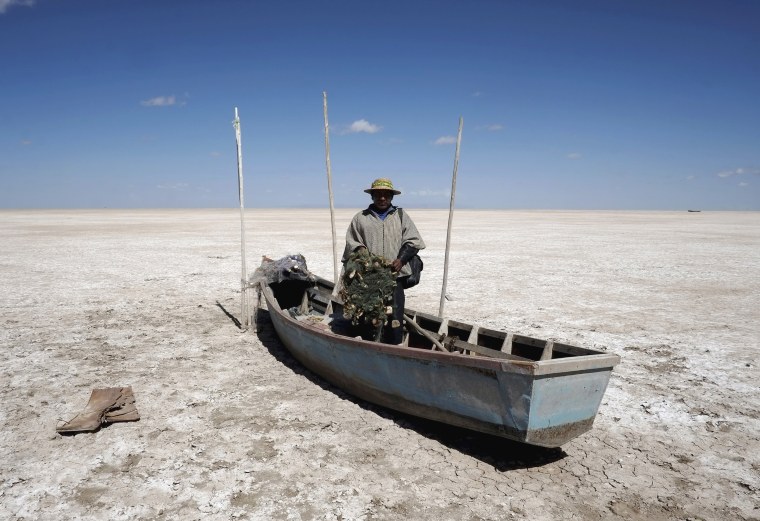
Those Bolivian Bishops have a lot to say when it comes to the environment, and Bolivia has been a leading country in fighting for the rights of Mother Earth. Bolivia is feeling the effects of climate change more than we are thus far. One of my kids visited the country and saw the huge mountain lake called Poopo that disappeared in 2015 due to water diversion and disappearing glaciers related to climate change. The lake will probably not replenish itself.I was happy to see that the Pope and his encyclical writing team addressed the issue of "carbon credits" in paragraph 171. It has never made sense to me that countries could pay a certain amount of money to "remove" so many tonnes of carbon dioxide from the atmosphere -- after the fact. If I fly to Tahiti and buy a carbon offset so that I can feel better about "dealing with" the greenhouse gas emissions caused by my tropical vacation, someone might plant a tree somewhere with that offset money, but it will take years for that tree to actually remove my emissions. It would be better not to fly at all... and maybe I need to be more serious about how I'm creating greenhouse gases from the beginning. That sacrifice I was talking about earlier.
Unfortunately, so far no one seems to be willing to sacrifice jet setting vacations. While I applaud people who do what they can to offset their air travel -- I'm not saying that carbon offsets are bad -- we also need to reconsider frivolous things like flying to warm places in the winter. And our big, polluting corporations need to stop polluting instead of buying carbon credits from developing countries that don't produce large amounts of greenhouse gases. The idea is to reduce our greenhouse gases and improve the health of our atmosphere, not just to maintain things at the present level of pollution!
Paragraph 172 references the difficulties faced by poor countries and the help they will need from wealthier nations to develop less polluting forms of energy production. It also contains the encyclical's first mention of solar energy as a solution, noting that
Taking advantage of abundant solar energy will require the establishment of mechanisms and subsidies which allow developing countries access to technology transfer, technical assistance and financial resources, but in a way which respects their concrete situations, since the compatibility of [infrastructures] with the context for which they have been designed is not always adequately assessed (Pontifical Council for Justice and Peace, Energy, Justice and Peace, IV, 1, Vatican City (2014), 53.)
It seems to me that, here in North America, we are too afraid to change, to take on our greater responsibility as people who live in countries that contribute the most to climate change. We think it will be too expensive, or too difficult, but in reality, climate change will be more expensive, and more deadly.
We're especially concerned about our livelihoods here in Alberta, where fossil fuel extraction and related industries have been our main employer for fifty years. But if we really think about it, fossil fuels are a dead end because our great-great-grandchildren can't live on a planet choked with greenhouse gases and terrorized by catastrophic events caused by an unstable climate.
We need to change now.
This makes me think of a young man who used to work in the Oil Sands near Fort McMurray. Paul saw that the future for highly polluting chemical processes to extract bitumen from the sand, water and clay up north was taking our environment downhill, fast. So he pulled the plug on that career and retrained to install solar panels. Rather than adding to climate change through his livelihood, he's participating in less polluting work in the alternate energy field and improving the earth's health, long term.
And more of us need to think this way. How can we change and find better ways to deal with the pollution created by our lives? How can we reduce waste? How can we save energy? How can we in North America, who have created greater greenhouse gas emissions with our larger homes, multiple vehicles, and excessive possessions, shoulder our greater responsibility for providing a solution to the problems our lifestyles have caused the planet?
What is one right thing we can do in the week ahead? Or one change we can make? Can we add to the grace of God's creation?
We found a way to help the ozone layer. Now we need to live in grace with the rest of our beautiful planet.
Sunday, February 16, 2020
Laudato Si Sunday Reflection: Taking nothing for granted

This week's reflection is brought to you by
1 Corinthians 2: 6-10.
O God,
you call us to a different kind of wisdom.
Not one that collects deep thoughts
or has deep pockets,
but the wisdom
that you alone can give,
the wisdom of appreciating
all that you give us.
Before the earth came to be
your wisdom was its glory.
The problem is
and continues to be
that those who speak your wisdom
have been reviled,
humiliated or crucified
figuratively
and
literally.
But you continue to offer
the kind of goodness and glory
that we find hard to realize,
things beyond our sight,
hearing,
and understanding.
Your Spirit
searches your creation
and speaks out
your depths
in the wisdom you give
through the wise ones among us
and the creation you offer to us daily.
Please,
Holy Spirit,
let us appreciate everything,
let us take nothing
for granted.
+Amen.
Some Indigenous community members understand this well, considering the next seven generations in their decision making. Do we?
Pope Francis gets it, too, saying, "The notion of the common good also extends to future generations," and reminding us that
Once we start to think about the kind of world we are leaving to future generations, we look at things differently; we realize that the world is a gift which we have freely received and must share with others. Since the world has been given to us, we can no longer view reality in a purely utilitarian way, in which efficiency and productivity are entirely geared to our individual benefit. Intergenerational solidarity is not optional, but rather a basic question of justice, since the world we have received also belongs to those who will follow us (paragraph 159).There are many big questions raised by Laudato Si, but for me, the one at the beginning of paragraph 160 is the biggest: "What kind of world do we want to leave to those who come after us...?" Pope Francis notes that this question is tied in to other questions about the meaning of life and why we are here, the goal of our efforts and our value to the earth itself -- questions whose answers speak volumes about our dignity as God's children.
Paragraph 161 deserves to be read in its entirety:
Doomsday predictions can no longer be met with irony or disdain. We may well be leaving to coming generations debris, desolation and filth. The pace of consumption, waste and environmental change has so stretched the planet's capacity that our contemporary lifestyle, unsustainable as it is, can only precipitate catastrophes, such as those which even now periodically occur in different areas of the world. The effects of the present imbalance can only be reduced by our decisive action, here and now. We need to reflect on our accountability before those who will have to endure the dire consequences.There have been more environmental catastrophes than I want to think about in the almost five years since Laudato Si was published. The burning of the Amazon and more recently, Australia, the extinction of more species, the Brazil mine tailings dam collapses, the plastic waste that continues to gather in our oceans, flooding, storms... The connection of these problems to our human activity can no longer be denied, and the dire catastrophes Pope Francis is speaking about may arrive sooner than we think.
He and his encyclical writing friends don't mince words in paragraph 162. Our present consumer culture has bred a society of people who are speeding up the earth's decline through our "rampant individualism" and "today's self-centred culture of instant gratification." We need to curb our "impulsive and wasteful consumption" so that we can "broaden the scope of our present interests and... give consideration to those who remain excluded from development" in both "intergenerational" and "intragenerational solidarity" -- the poor of the future, and those we have with us now.
Such solidarity demands the most from those of us who live in the developed world. If everyone on the planet lived like we do, we would probably need another dozen earths to support the present world population. (Check out your ecological footprint by clicking here.) We need to re-examine what we see as essential to our standard of living. How can we live more simply and meaningfully without consuming so many of our planet's resources?
We are told that Mother Earth has enough for all her children, but the problem is that some of us children use up more than our share, which impoverishes those who are living in poverty now, and future generations who may not have enough. It also messes up our planet for all living things. How many species will be extinct when my children are my age? Will future generations ever be able to drink from a mountain stream like I did when I was small?
Laudato Si is the best commercial I know for simple living. Once we build an awareness of where our greed has gotten the better of us, we can begin to appreciate what we already have and live a deeper solidarity with the poor and future generations. In appreciating the gifts God has already given us, we can more easily ignore the way consumer culture leads us to want more than we need.
If we can ask ourselves the four questions on this poster on a regular basis, we can change our way of life to one that is better for all that God has made. Or perhaps you can make your own version with your own awareness-raising questions.
We all need enough to live, but we don't need too much, especially when our greed pollutes our planet, impoverishes creation, and harms the seven generations that come after us. I don't know about you, but I hate feeling greedy. Feeling appreciative is the way to go, the Spirit moving in us all!
Thursday, June 6, 2019
Happy Environment Week!
Sunday, June 2, 2019
Laudato Si Sunday Reflection: How do we receive God's love letter?
This Sunday reflection is brought to you byEphesians 1:17-23.
God of glory,
you give us a spirit of wisdom and revelation.
You enlighten our hearts.
You show us
the hope to which you call us.
You bless us
with the abundance of glorious inheritance
our earth has to offer.
Your great power is visible
in the many resurrections of spring.
You can be seen
in all that you have made,
you rise above all human rule and authority and power and dominion
and every name that is or will ever be.
You are the fullness we seek.
Help us not to settle for less than your love
moving in us
and in our protection
of your world.
+Amen
This week's smoky skies had a lot of people musing about the apocalypse, but as I walked our pup with a smoke tickle in the back of my throat, I found myself moodling about this amazing world God has given us to inhabit, this love letter that we too often trample in the dust rather than keep carefully.
This isn't exactly the way I intended to start this reflection, but the wildfires displacing so many of our human family in Northern Alberta played heavily on my mind as I reflected on today's paragraphs (81-85) from Laudato Si: On Care for Our Common Home, which can be accessed by clicking here.
The question on my mind was, "How do we receive God's love letter more gratefully and carefully?"
Paragraph 81 looks at the fact that every human being on earth has developed or is developing into a unique creature with our own ways of being: "The sheer novelty involved in the emergence of a personal being within a material universe presupposes a direct action of God and a particular call to life and to relationship" not only with God, who addresses herself and himself to me, but also with creation. Each one of us is a subject who can never be reduced to the status of an object by virtue of those relationships.
"When nature is viewed solely as a source of profit and gain, this has serious consequences for society." And not only society, but nature as a whole. Not only are people being forced to flee the fires, but many creatures' natural habitat is being lost due to human-caused climate change.
I'm so glad that the human idea that "might is right" is noted by Pope Francis and his encyclical team in paragraph 82. It's a fallacy that has led to immense inequality, injustice and violence against the majority of humanity, many other species, and our environment, since resources are exploited by the wealthiest, the most powerful, or the first on the scene. Of course, "Completely at odds with this model are the ideals of harmony, justice, community and peace as proposed by Jesus," who told us not to use power over one another, but to serve each other (and, I believe he also intended that we serve all of creation).
Paragraph 84 notes that "Our insistence that each human being is an image of God should not make us overlook the fact that each creature has its own purpose." But where I beg to differ, Pope Francis, is in my assertion that each creature is as much an image of God as I am! God is not contained only in human beings -- "The entire universe speaks of God's love" and life. We human beings are putting God into a very small box when we forget that all creatures are part of God's image, just as we are.
Paragraph 85 notes that in creation, God has written a precious book, but going back to the beginning of this reflection, I prefer to think of it as a love letter. This idea of God as a lover writing a love letter first hit me as I was working on a novel in which one character says to another,
How many lovers have you had who could woo you with a gorgeous winter sunset like the one we had this evening? How many lovers could create a planet like the one I live on, and give it to me as a free gift? How many lovers could place entire diamond galaxies out in space just for us to marvel at with our dinky little telescopes? And how many lovers could create human love to show us the overarching love behind everything that is?The Canadian bishops say, "From panoramic vistas to the tiniest living form, nature is a constant source of wonder and awe. It is also a continuing revelation of the divine." Everything God made holds a lesson for us -- "for the believer, to contemplate creation is to hear a message, to listen to a paradoxical and silent voice." And what is that message?
That we are loved.
In seeing the world's sacredness, created out of God's love, we also find our sacredness, and an encouragement to love creation as God loves it.
Where will you notice God's love letter for you in the week ahead? And what love letter will you give back to creation? Is there one small way you can reduce your fossil fuel emissions this week, to help decrease the incidence of future wildfires?
Sunday, May 26, 2019
Laudato Si Sunday Reflection: Doing our part
Psalm 67.
Let all of creation praise you,
O God,
let all of creation praise you.
Human beings are too small
to sing your glory sufficiently.
I suspect that's why we have
birdsong,
ocean storms,
mountain meadows,
prairie skies
and everything else you have made.
Thank you
for being so gracious to us;
for letting your glory and goodness
surround us.
Anyone can see
your face
with the eyes of our souls --
your beauty, goodness and truth
can be found everywhere
that people remember to walk
in your love.
In those who become
your hands and feet
lies your way,
your saving power.
In spite of the challenges we face,
let us be glad and sing for joy.
You judge us fairly
and guide our ways.
You make all the spring beauty that surrounds us
and bless us beyond all measure.
Help us to cooperate with you,
with creation,
in creating more of your beauty, goodness and truth
for all those who cannot see it.
Awaken them to all that you have given,
so that we may all do our part
to care for your creation
together.
+Amen.

This week's piece of Laudato Si, is about The Mystery of the Universe (paragraphs 76-80, which can be accessed by clicking here). I'm thinking that there are too many mysteries to count when it comes to the universe and God's care for one particular planet and its inhabitants.
Paragraph 76 notes that "Nature is usually seen as a system which can be studied, understood and controlled, whereas creation can only be understood as a gift from the outstretched hand of the Father of all, and as a reality illuminated by the love which calls us together into universal communion."
In paragraph 77, the Pope and his writing team assert that the creation of the universe wasn't a random occurrence or "arbitrary omnipotence," but rather, was the result of God's choice to create out of love, and that everything created exists because of that love. For me, it's impossible to imagine that everything surrounding us in creation is the result of randomness. It makes more sense that something, Someone, namely our Tender God, enfolds everything with love and holds it in balance so that it continues to exist. And it has become rather obvious that humans' upsetting of that balance is the reason that things are starting to fall apart.
Ancient pagan religions saw nature as divine, and I can't help but wonder if that wasn't closer to God's intent than the Judaeo-Christian thought that "demythologized nature" according to paragraph 78. Demythologizing nature might have been fine if human beings had taken responsibility for valuing and protecting it the way God does, but it seems our connection to both God and nature have never been quite strong enough to hold everything in balance the way God does. We are only human, and we have periods of doubting God -- or forgetting that we are not God! More recently, the influence of "the modern myth of unlimited material progress" has led too many of us to Mammon (greed) rather than toward the wise direction, development and limitation of our powers as intelligent creatures created by God.
In paragraph 79 we find that "In this universe... we can discern countless forms of relationship and participation....We are free to apply our intelligence towards things evolving positively, or towards adding new ills, new causes of suffering and real setbacks...." God has given us choice, over and over again. In his letter to the world, Pope Francis reminds everyone of our duty to care for nature and protect humanity from self-destruction.
Thanks be to God that He and She is reliable. Paragraph 80 reminds us that God can bring good out of the problems human beings have caused. I love the line from Pope John Paul II's Catechesis: "The Holy Spirit can be said to possess an infinite creativity... which knows how to loosen the knots of human affairs, including the most complex and inscrutable." But we can't let moments of positivity lull us into a sense that God is going to fix everything without us lifting even a finger. Unfortunately, there are people on this earth who think that way, and they are part of the problem!
The Holy Spirit's infinite creativity resides in each one of us, and as Saint Teresa of Avila liked to say, we are all the hands and feet and heart of Christ. So now the question is, what are we going to do as part of God's action on this planet? How can we put the Spirit's creativity to work in ourselves, for our world?
It's becoming clear that we can't expect world leaders to make changes -- we need to push them, and to change our own lifestyles too. That means giving our communities and ourselves an energy audit. If we really want to prevent further climate change, we all need to become more aware of the places in our lives where we are creating needless carbon emissions, and reduce the size of our carbon footprint. Change begins with us.
75 years ago, hot water was pretty much considered a luxury, but now it's an expectation that creates a fair bit of waste if we really think about it. My parents talk about the "weekly bath" that was shared in their families. Our present culture likes our daily hot showers -- but since the last time I read this part of Laudato Si, I decided to only shower every second or third day to live in solidarity with our brothers and sisters who don't have the option of a daily shower. I'm also trying to shower for less than 5 minutes, hoping to slow climate change for the sake of my children and (future) grandchildren.
And there are many other things to consider. Are we willing to give up idling our cars? Using automatic car starters? (I saw a vehicle idling this gorgeous, warm spring morning -- why???) Are we willing to use public transportation if the option exists? Are we willing to buy local food instead of exotic items that have to be trucked halfway across the globe? Where else can we cut our energy use?
What are we willing to do? And what would you like to ask our world leaders to do? Why not write a politician a letter to encourage them to see the environment rather than the economy as our communal bottom line?
One thing's certain -- things have got to change. And we have the power to start things rolling, even just in our own lives!
Tuesday, May 14, 2019
A Mother Earth Mother's Day
But this past Mother's Day weekend, I had nothing but time with my best friend, who lives in Duncan, BC. Instead of presents for our birthdays, we decided to enjoy each others' presence. And it just so happened that my visit with Cathy coincided with a Cowichan 101 session offered by some elders of the Cowichan Tribe in the form of a trip to T'l'oqwxwat, known (in English) as Avatar Grove. It's an old-growth forest that was saved from logging in 2009. Click here to read the story of how Avatar Grove came to be protected by the Ancient Forest Alliance. And if you love old forests, consider contributing to the cause.
At 8:30 a.m., about 35 people from the Duncan area boarded Lisa's school bus for what felt like a long drive toward Port Renfrew, and a bit further up a very bumpy logging road to the Grove. There were a half dozen vehicles parked on the edge of the road near a small sign that offers very little indication of the wonders above and below it.
After we hiked up a fairly well-made path to "Canada's Gnarliest Tree," we gathered to hear two Cowichan leaders, Fred and Rob, speak about the forest and its abundant healing properties. They sang and drummed for us, talked about the medicines found in old-growth forests, and about how their ancestors spent 40 years cutting and hollowing out thousand-year-old trees to build sea-going canoes that took them all the way to Malibu in California.
Fred played his Salish wind instrument so beautifully that tears rolled unbidden down my cheeks. I sat against a several hundred-year-old tree, set my camera to record and laid it in my lap so that I could just listen, breathe, pray, and watch the gorgeous movement overhead.
Avatar Grove is a sacred place to the Cowichan peoples -- as all old-growth forests should be for all of us. Our leaders invited us to offer prayers there, to lay down our burdens at the feet of the trees, to settle against them and asbsorb their goodness and the pure air they offer. I can't begin to describe amazing presence there.
If you're ever out Port Renfrew way and can make your way up a bumpy forestry road to T'l'oqwxwat/Avatar Grove, it's definitely worth the trip. There's nothing like sitting on the knee of a six-hundred-year-old Douglas Fir and breathing with her. Especially on Mother's Day weekend. I'm so blessed...
Deepest gratitude to Lisa, Rob, and Fred.
Tuesday, November 14, 2017
Simple Suggestion #268... Drive smarter
Did you hear about the World Scientists' Warning to Humanity: A Second Notice in the news yesterday? Being released on what was the statutory Remembrance Day holiday for many people, its timing wasn't the best, as often happens with these very important news items.Basically, 15,364 scientists from 184 countries around the globe (the most co-signers of a journal article ever recorded) signed a joint statement (please, go ahead and read it by clicking here or on its title above -- it's a quick and informative read). The Warning's signatories are doing what they can to push us, earth's human citizens, toward reducing greenhouse gas emissions, restoring damaged ecosystems, limiting human population growth, and reining in material consumption. They share information about our planet's losses since the first warning in 1992, and tell us:
To prevent widespread misery and catastrophic biodiversity loss, humanity must practice a more environmentally sustainable alternative to business as usual. This prescription was well articulated by the world's leading scientists 25 years ago, but in most respects, we have not heeded their warning. Soon it will be too late to shift course away from our failing trajectory, and time is running out. We must recognize, in our day-to-day lives and in our governing institutions, that Earth with all its life is our only home.In understanding that Earth is our only home and that it is in serious trouble (as Pope Francis noted in his June 2015 letter to the world, Laudato Si:On Care for Our Common Home), we need to make some serious sacrifices. The scientists' warning offers many suggestions for transitioning to a more sustainable world, and encourages us to look at how we can live more sustainably to reduce our impact on our over-stressed planet and to work from the grass roots to bring about change. Which changes can we make right now?
One thing that we have done as a family was to give up certain conveniences, including our second car. It's been challenging at times when people are going in different directions, but living in a city, we are fortunate to have transit or taxis (or family and friends to help us out on occasion) when too many things are happening at once. We've also forgone attending the odd event just because it wasn't possible to make our single family vehicle bilocate.
But for many people in our spacious and vehicle-oriented country, it's not possible to give up personal transportation. So for those of us who have vehicles, a number of organizations (including the City of Edmonton) have joined with an online program called the Smart Drive Challenge, a program designed to teach us how to be more efficient with the fossil fuels we do use. Click on the highlighted link above to check it out.
Of course, even better than taking the Smart Drive Challenge would be to give up vehicles altogether -- like my friend Terry has. She's been car-less for years, has saved a fortune in insurance, gas, maintenance and registration fees, and only rents a vehicle once in a while for those things she can't do on foot or by public transportation. I wonder how many fewer greenhouse gases she's responsible for. Terry proves that it IS possible to go one step further than driving smarter, and simply give up having a car in Edmonton for most days of the year. But make no mistake, it is a sacrifice. She's at the mercy of our transit schedules a lot of the time, and bus service here seems to end at the supper hour in many cases.
Going car-less is a really radical idea, but somehow, I suspect that our 15,364 scientists would approve. If that's a bit too radical for you, I'll bet they'd give a secondary thumbs up to the Smart Drive Challenge. Try it!
Sunday, October 22, 2017
Giving to God the things that are God's
O God,we are all stardust.
We do not make ourselves,
and everything we create
is invented from the materials
that you provide.
So really,
nothing belongs "to Caesar" --
everything is yours.
That's not to say
that we shouldn't pay taxes
that help to support our social structures
and the lives of those less fortunate.
It's just to say
that we need to remember
that you are the Source of All Being,
and to hold in reverence
all that is,
all that you are.
You are present in the tiniest amoeba
and the largest whale.
You live in the forests
and in the hearts of people
with a different world view than our own.
So when you ask us to
"Give therefore to Caesar
the things that are Caesar's,
and to God the things that are God's,"
I hear your invitation
to cooperate with you
in caring for your creation.
Help me to be always aware
of the ways I can improve
in my collaboration
with all the other creatures
who come from stardust.
+Amen.
Sunday, February 19, 2017
All we need is radical love
Of course, it's not Christ's fault, he who said that we need to live non-violently, go the extra mile for our sisters and brothers on the margins, love our enemies, be perfect as God is perfect and a few dozen other basic things that we seem to have forgotten in our relatively comfy, privileged pews. It's a rough, raw, radical love that Jesus expects of us, one that takes a hit without hitting back and still moves forward in humility, generosity, patience and compassion. It's how he lived -- his kind of radical love reaches through the centuries -- otherwise we never even would have heard of a small town preacher and healer from a backwater town in the middle East.
The word radical comes from the Latin word for root. Radical love roots our lives in the important things in life so that we can ignore the inconsequential ones and live simply, out of love. The only way our world will survive is if we return to radical love for our planet, for others, for creation, and for ourselves. We need to work for the common good, to turn the other cheek, to give our life energies to goodness, to love our enemies, to pray for those who persecute us and do all the other radical things that Jesus himself chose to do right to the end.
A tall order. But we're seeing far too much radical hatred these days, and it's clearly not the way our world needs to go.
What acts of radical love will you engage in this week? They don't have to be anything heroic, just rooted in love.
Tuesday, April 14, 2015
Simple Suggestion #230... Organize a neighbourhood clean-up
Which is why I'm so glad for Capital City Cleanup, a program in my city that encourages residents, schools, businesses and organizations to get involved in making our neighbourhoods cleaner and safer. The Adopt a Block program invites Edmontonians to make a regular habit of picking up litter with family and friends as we walk our neighbourhoods, or favourite park paths or trails, with a volunteer website to register our chosen areas.
And the 28th annual River Valley Clean Up is coming soon, the first Sunday of May. I'm thinking it might be a day to skip church and get involved, hands on, in caring for creation with my kids.
But even if there are no clean up programs where my moodling readers live, it's really easy to start your own. When our kids were smaller, my neighbour and I chose a spring afternoon each year and cleaned the little area park across the street with our kids. It's good to teach our young ones the importance of protecting our environment from pollution and waste, and picking up litter (with appropriate safety precautions in place -- gloves, adult supervision, and a lesson about getting the adults to dispose of sharp or dangerous things) is one simple way to do it.
So this Simple Suggestion is a really a simple challenge in disguise. Why not organize your own neighbourhood clean-up? As we head into spring, if we all clean up more than our own property, we're doing the earth and each other a favour. And we're simply showing respect for the beautiful world in which we live.