Showing posts with label sacrifice. Show all posts

Sunday, March 8, 2020

Laudato Si Sunday reflection: Adding to the grace of God's creation


This week's reflection is brought to you by
2 Timothy 1: 8b-10

O Christ,
you call us to join together with you
in suffering for the Gospel,
which translates to
love.

You showed us what real love is
by uniting with us
in our humanity
and teaching us
to serve one another.

Your grace is enough for us.

Let us be your grace
in all that we say,
do,
and are.

And let the grace of your creation
be foremost in our minds
in all that we say,
do,
and are,
so that we may care for it
and for each other
as you do.

+Amen

* * * * * * *

This week's section of Pope Francis' encyclical, Laudato Si: On Care for Our Common Home reminds us that humanity is capable of working together to change the course of history when it comes to caring for our planet. We're looking at paragraphs 168 to 172, which you can access by clicking here and scrolling down. Paragraph 168 carries an important message about positive experiences where different conventions made good decisions for the sake of life on earth: the Basel Convention on Hazardous Wastes, the Convention on international trade in endangered species, and the Vienna Convention for the protection of the ozone layer, which led to the Montreal Protocol which eliminated the CFCs which were creating the ozone hole.

When the ozone hole was discovered, it was a serious problem for the entire planet. And global climate change is the same sort of problem -- there is nothing on earth that isn't affected by weather which causes droughts and fires, floods and disasters. Edmonton had a tornado in 1987. Calgary had the flood of 2013. And for most of us in Alberta, these were fairly minor events. But for people living in developing countries, fires, floods, typhoons and drought cause more deaths and destruction than we can imagine, because the people in the developing world don't possess the resources we have to deal with such disasters.

"With regard to climate change, advances have been regrettably few," says the Pope in Laudato Si, his letter to the entire world. "Reducing greenhouse gases requires honesty, courage and responsibility, above all on the parts of those countries which are more powerful and pollute the most" (paragraph 169). That would be most of the countries in the western world, including us. I wish the Pope had also used the word, sacrifice, because I believe that it's getting to the point where we might have to be willing to give certain things up for the health of our planet.

Unfortunately, our political leaders prefer to point fingers at other countries, poorer than ours, who aren't doing their share to protect the environment. So we in Canada have wasted valuable time, and aren't doing enough to stop climate change as of yet. But the Pope reminds us:
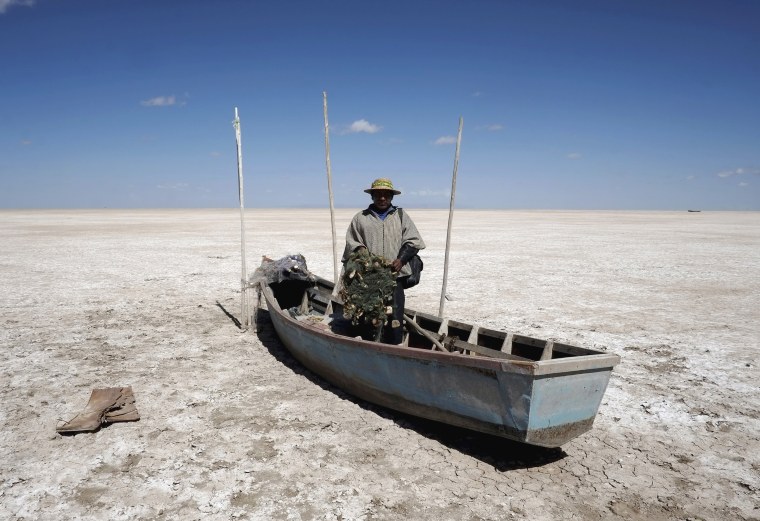
there is a need for common and differentiated responsibilities. As the bishops of Bolivia have stated, "the countries which have benefited from a high degree of industrialization, at the cost of enormous emissions of greenhouse gases, have a greater responsibility for providing a solution to the problems they have caused." (Quote from the Bolivian Bishops' Conference Pastoral Letter on the Environment and Human Development in Bolivia, El universo, don de Dios para la vida from March 2012 (86).)
Image: Fisherman Rene Valero, from the Urus ethnic group, is seen on his boat on the dried Poopo lakebed in the Oruro Department, south of La Paz, BoliviaThose Bolivian Bishops have a lot to say when it comes to the environment, and Bolivia has been a leading country in fighting for the rights of Mother Earth. Bolivia is feeling the effects of climate change more than we are thus far. One of my kids visited the country and saw the huge mountain lake called Poopo that disappeared in 2015 due to water diversion and disappearing glaciers related to climate change. The lake will probably not replenish itself.

I was happy to see that the Pope and his encyclical writing team addressed the issue of "carbon credits" in paragraph 171. It has never made sense to me that countries could pay a certain amount of money to "remove" so many tonnes of carbon dioxide from the atmosphere -- after the fact. If I fly to Tahiti and buy a carbon offset so that I can feel better about "dealing with" the greenhouse gas emissions caused by my tropical vacation, someone might plant a tree somewhere with that offset money, but it will take years for that tree to actually remove my emissions. It would be better not to fly at all... and maybe I need to be more serious about how I'm creating greenhouse gases from the beginning. That sacrifice I was talking about earlier.

Unfortunately, so far no one seems to be willing to sacrifice jet setting vacations. While I applaud people who do what they can to offset their air travel -- I'm not saying that carbon offsets are bad -- we also need to reconsider frivolous things like flying to warm places in the winter. And our big, polluting corporations need to stop polluting instead of buying carbon credits from developing countries that don't produce large amounts of greenhouse gases. The idea is to reduce our greenhouse gases and improve the health of our atmosphere, not just to maintain things at the present level of pollution!

Paragraph 172 references the difficulties faced by poor countries and the help they will need from wealthier nations to develop less polluting forms of energy production. It also contains the encyclical's first mention of solar energy as a solution, noting that
Taking advantage of abundant solar energy will require the establishment of mechanisms and subsidies which allow developing countries access to technology transfer, technical assistance and financial resources, but in a way which respects their concrete situations, since the compatibility of [infrastructures] with the context for which they have been designed is not always adequately assessed (Pontifical Council for Justice and Peace, Energy, Justice and Peace, IV, 1, Vatican City (2014), 53.)
I am underlining and bolding the statement that follows the above comment: "The costs of this would be low, compared to the risks of climate change."

It seems to me that, here in North America, we are too afraid to change, to take on our greater responsibility as people who live in countries that contribute the most to climate change. We think it will be too expensive, or too difficult, but in reality, climate change will be more expensive, and more deadly.

We're especially concerned about our livelihoods here in Alberta, where fossil fuel extraction and related industries have been our main employer for fifty years. But if we really think about it, fossil fuels are a dead end because our great-great-grandchildren can't live on a planet choked with greenhouse gases and terrorized by catastrophic events caused by an unstable climate.

We need to change now.

This makes me think of a young man who used to work in the Oil Sands near Fort McMurray. Paul saw that the future for highly polluting chemical processes to extract bitumen from the sand, water and clay up north was taking our environment downhill, fast. So he pulled the plug on that career and retrained to install solar panels. Rather than adding to climate change through his livelihood, he's participating in less polluting work in the alternate energy field and improving the earth's health, long term.

And more of us need to think this way. How can we change and find better ways to deal with the pollution created by our lives? How can we reduce waste? How can we save energy? How can we in North America, who have created greater greenhouse gas emissions with our larger homes, multiple vehicles, and excessive possessions, shoulder our greater responsibility for providing a solution to the problems our lifestyles have caused the planet?

What is one right thing we can do in the week ahead? Or one change we can make? Can we add to the grace of God's creation?

We found a way to help the ozone layer. Now we need to live in grace with the rest of our beautiful planet.

Saturday, May 14, 2016

Laudato Si: Sunday Reflection #38... The market ain't magic

I have to admit this Pentecost Sunday that it's getting harder and harder to put in the time to do these reflections now that the weather is fine and the garden is ready to be planted. But we're so close to finishing these Sunday readings that I'm not about to quit. We're into good stuff!

This week's reading from Laudato Si: On Care for Our Common Home, paragraphs 189-193, is the first half of a section entitled Politics and Economy in Dialogue for Human Fulfilment. It can be accessed by clicking here and scrolling down.

"In view of the common good, there is urgent need for politics and economics to enter into a frank dialogue in the service of life, especially human life" says the beginning of paragraph 189. Augghhh! This business of differentiating human life from that of the rest of the planet has created the "us vs. them" attitude that has allowed human beings to dominate rather than cooperate with creation. Here it would seem that the folks who wrote the encyclical with Pope Francis are forgetting the chorus of the song -- "everything is connected and/or interrelated." I'd like to erase that "especially human life" at the end of the sentence. Isn't it enough to be in the service of life?

I do go off on tangents, sorry. The point of paragraph 189 is that too often, necessary production of goods to keep life going gets waylaid by political or economic machinations, leading to "overproduction of some commodities, with unnecessary impact on the environment and with negative results on regional economies." The financial bubbles created by such production create a false economy, but Pope Francis suggests that "it is the real economy which makes diversification and improvement in production possible, helps companies to function well, and enables small and medium businesses to develop and create employment."

I like paragraph 190, in which Pope Francis notes (using different words than I will, so you'll want to read the whole thing) that the environment, not the economy, is the bottom line -- "...we need to reject a magical conception of the market."

Yes! Yes we do!

The Pope also asks, "Is it realistic to hope that those who are obsessed with maximizing profits will stop to reflect on the environmental damage they will leave behind for future generations?" In paragraph 190, the Pope could be writing his own adult version of Dr. Seuss' classic children's book, The Lorax.
Image result for the lorax
If you've never read The Lorax, I'd recommend it -- it's the story of a little guy who lives in an idyllic place full of truffula trees, singing swomee swans, humming fish and little brown barbaloots who eat truffula fruit, until the Once-ler comes along, founds something like a corporation to turn the trees into thneeds (some sort of all-purpose trendy item that everyone wants -- in every colour of the rainbow). Of course, the Lorax sees the decimation of the truffula forests and the ensuing decline in the health and happiness of his animal friends. He tries to call a halt to the Once-ler's plans, but the Once-ler is too busy to listen. So environmental devastation results, the Lorax has to send away his loveable wildlife friends (it's a children's book -- extinction would be too harsh), the gorgeous green landscape turns many depressing shades of grey, and the Lorax sadly lifts himself into the sky by the seat of his pants, leaving the Once-ler all alone with a single word -- "Unless."

"Unless someone like you cares a whole awful lot,
nothing is going to get better. It's not,"

the regretful hermit of a Once-ler tells a young visitor to his despoiled land as he hands over the last truffula tree seed. Written in 1971, The Lorax is the earliest environmental fable I can think of besides the Garden of Eden and Noah's ark.

In paragraph 191 the Pope notes that "some" accuse "others" (read: environmentalists) of "irrationally attempting to stand in the way of progress and human development just as the Lorax tried to make the Once-ler see the folly of his ways. But really, it isn't irrationality -- it's common sense that "we need to grow in the conviction that a decrease in the pace of production and consumption can at times give rise to another form of progress and development." Growth can no longer be our highest ideal -- but sustainability can!

The Pope and friends hold up "productive development" as an ideal in paragraph 192 because it "offers the fullest possibilities to human ingenuity to create and innovate, while at the same time protecting the environment and creating more sources of employment." Sustainable development means being aware of the many possibilities for growth, but letting some of them go in favour of protecting creation, using less, employing the ideas of "reusing, revamping and recycling," and increasing the efficiency of our energy use, to name just a few possibilities.

Paragraph 193 indicates that growth needs to be balanced or contained "by setting some reasonable limits and even retracing our steps before it is too late... the time has come to accept decreased growth in some parts of the world, in order to provide resources for other places to experience healthy growth."

If we look at the development in our world, we can see that in North America, we've had more than our fair share of growth. So how do we encourage more sober lifestyles, reduce our energy consumption and improve our efficiency as was suggested in the quote from Pope Benedict XVI toward the end of the paragraph?

We might have to employ a word that people in North America have forgotten in our rush to have it all -- we might have to sacrifice our over-abundant standard of living by forgoing some of the conveniences and experiences to which we've come to believe we are entitled. We might have to un-brain-wash ourselves from thinking that the newest, trendiest, fastest, biggest, smartest, brightest items on the market will fulfil all our desires. We might have to realize that unlimited market growth is limiting our ability to live in harmony with our sister, Mother Earth because it demands too many resources. We might have to remember how to be happy with less.

In other words, we might have to live by the fruits of the Spirit that we are celebrating on this Pentecost Sunday, and apply them to our care for our common home -- love, joy, peace, patience, kindness, generosity, faithfulness, gentleness and self-control (Galatians 5: 22).

A stronger desire for these fruits in our lives, especially that last one, will help creation more than any market ever has... don't you think?

Image result for Unless

*******
A prayer for our earth

All-powerful God, you are present in the whole universe
and in the smallest of your creatures.
You embrace with your tenderness all that exists.
Pour out upon us the power of your love,
that we may protect life and beauty.
Fill us with peace, that we may live
as brothers and sisters, harming no one.
O God of the poor,
help us to rescue the abandoned and forgotten of this earth,
so precious in your eyes.
Bring healing to our lives,
that we may protect the world and not prey on it,
that we may sow beauty, not pollution and destruction.
Touch the hearts
of those who look only for gain
at the expense of the poor and the earth.
Teach us to discover the worth of each thing,
to be filled with awe and contemplation,
to recognize that we are profoundly united
with every creature
as we journey towards your infinite light.
We thank you for being with us each day.
Encourage us, we pray, in our struggle
for justice, love and peace.

+AMEN.

(A prayer for our earth and all quotations from Laudato Si: On Care for Our Common Home © Libreria Editrice Vaticana)

Next up: Redefining 'progress'

Sunday, April 24, 2016

Laudato Si: Sunday Reflection #36... "Truly, much can be done!"

It's too early for pear blossoms!
I've noticed, in my reading of Laudato Si: On Care for Our Common Home, that the Pope isn't one for using exclamation marks. His encyclical quotes people who use them often enough, and he has included many exclamatory scriptural quotations, but for the most part, his letter is fairly solemn. The title of this reflection is his third of only three exclamations... and it is our reason for hope in spite of the many difficulties facing our planet.

This Sunday we're looking at paragraphs 178 to 181 of Laudato Si, which can be accessed by clicking here and scrolling down. I think these paragraphs are particularly relevant given that 175 countries signed the Paris Climate Agreement this week. Did you know that Canada is among the top ten CO2 emitters, creating 2% of the world's greenhouse gases, though our country is 38th in population?

Paragraph 178 addresses a concern that arises when it comes to any Climate Agreement. The Paris Agreement has been adopted in order to keep our planet's temperature increase below 2 degrees (over pre-industrial levels) due to global climate change. Pope Francis notes that the world's politics are too focused on immediate results, market dynamics and short-term growth, and that politicians are afraid to adopt measures that might upset the public for fear of losing their government positions. But as the encyclical says, "True statecraft is manifest when, in difficult times, we uphold high principles and think of the long-term common good." These days, our politicians need to be prophets who are willing to go against market forces, think outside the box and come up with better ideas than the old ways that are destabilizing our climate.

Such prophets are already among us, did you know? Paragraph 179 talks about them:
,,, cooperatives are being developed to exploit renewable sources of energy which ensure local self-sufficiency and even the sale of surplus energy... local individuals and groups can make a real difference. They are able to instil a greater sense of responsibility, a strong sense of community, a readiness to protect others, a spirit of creativity and a deep love for the land. They are also concerned about what they will eventually leave to their children and grandchildren. These values are deeply rooted in indigenous peoples.
And they should be rooted in every person on the planet, enabling us all to work together to pressure our governments for "decisive political action." We can all be prophets!

But things have broken down somewhere -- and I think I know where. If we ask the average Andrew or Alicia about the last time they contacted their government officials about environmental concerns, we'll likely get a blank look. Having been brainwashed into believing that independence is better than interdependence, too many of us have forgotten that our leaders will only respond if enough voices are raised. We forget our own prophetic role in calling them to bring about the radical changes needed, never raising our voices to demand decisive political action, so our leaders assume we're happy with the status quo.

But clearly, the status quo isn't working. My pear tree doesn't usually bloom until May 12, but it's blooming almost three weeks early this year. A wildfire ran through the Wolf Willow/Rio Terrace ravines here in our Edmonton river valley Friday night because everything is so dry when really, there should still be snow on the ground. Climate change is happening here in Edmonton -- and everywhere else -- and it's time we take it seriously and demand that our leaders do the same -- to ratify the Paris Climate Agreement by exceeding its targets and setting an example for all of the top ten emitters to follow.

Of course, it isn't easy to be a prophet -- especially when many people in Alberta's energy-based economy have already lost jobs. Of course, the unemployment we are seeing is a sign that we need to come up with a different employment model since the world is realizing that fossil fuels are a literal dead end for our earth. Paragraph 180 of Laudato Si is packed with ideas that might drive a different model for employment. How many local industries could arise from the points below?

  • increased energy conservation
  • better industrial production to maximize energy efficiency and minimize raw materials
  • reduction of energy inefficient, polluting products (and, I would hope, an end to planned obsolescence)
  • improvement of transport systems
  • construction and repair of buildings for high energy efficiency and low pollution
  • reduced consumption (through consumer education)
  • improved waste disposal and recycling
  • protection of species
  • diversification of agriculture through crop rotation
  • improvement of rural infrastructure
  • better organization of local and national markets
  • improved irrigation 
  • the development of sustainable agricultural techniques
  • cooperation and community organization to defend small producers
  • preservation of local ecosystems
"Truly, much can be done!" say Pope Francis and his encyclical writing team at the end of paragraph 180. If humanity turns its focus away from fossil fuel industries and develops capabilities in the areas noted above, how long would unemployment be a problem? Perhaps it would continue in the short-term, but we need to start thinking longer-term for the sake of future generations. What is the saying? Short-term pain for long-term gain.

Which leads us right into paragraph 181. It says that we need continuity when it comes to handling climate change: "...environmental protection cannot be altered with every change of government. Results take time and demand immediate outlays which may not produce tangible effects within any one government's term." 

Our leaders don't want to be prophets. Often, standing up for what is right and just means bucking political trends and asking for change from the public, the people they're trying to keep happy. What I've noticed lately, though, is that the public seems to be way ahead of our political leaders in looking for change when it comes to climate policy. Politicians in Canada are still talking about pipelines, but many of their constituents are dreaming about alternate energy sources instead -- have you noticed?

Unfortunately, dreaming isn't enough. We need to demand change. With a phone call, a letter, an email, or a text message, since our leaders can't read our minds. And we also have to be willing to sacrifice convenience to bring change about. Can we live on less if it means more people can share jobs until the energy sector evolves? Can we drive less and walk or take public transportation more to cut down on greenhouse gases? How about buying locally instead of creating demand for items that travel long distances and use many fossil fuels to get to us? Having local vacations instead of tropical ones? Conserving every last bit of energy that we don't need to use by turning things off instead of leaving them running if we leave the room (I'm working on this one -- too often I walk away in the middle of writing these Laudato Si reflections and get sidetracked by other things, only to come back later and realize that energy was a-wasting...)

As prophetic participants in a world that needs to change, what will we do in the weeks and months ahead?

As Pope Francis says, "Truly, much can be done!" 


*******
A prayer for our earth

All-powerful God, you are present in the whole universe
and in the smallest of your creatures.
You embrace with your tenderness all that exists.
Pour out upon us the power of your love,
that we may protect life and beauty.
Fill us with peace, that we may live
as brothers and sisters, harming no one.
O God of the poor,
help us to rescue the abandoned and forgotten of this earth,
so precious in your eyes.
Bring healing to our lives,
that we may protect the world and not prey on it,
that we may sow beauty, not pollution and destruction.
Touch the hearts
of those who look only for gain
at the expense of the poor and the earth.
Teach us to discover the worth of each thing,
to be filled with awe and contemplation,
to recognize that we are profoundly united
with every creature
as we journey towards your infinite light.
We thank you for being with us each day.
Encourage us, we pray, in our struggle
for justice, love and peace.

+AMEN.

(A prayer for our earth and all quotations from Laudato Si: On Care for Our Common Home © Libreria Editrice Vaticana)

Next up: Ten important questions

Friday, February 25, 2011

Courage, sacrifice, humility, and hard work

Do you watch TV? I've pretty much given it up, as I don't find present-day TV shows to be terribly inspiring. My one hour of television per week lately is a show I don't really like, but watch in order to know what my daughters are into. Having embraced Voluntary Simplicity makes it really hard for me to watch television because so much of it is about excess, and it makes me sad to see people so focused on stuff. If I really did watch TV, it would probably be mostly nature shows and concerts.

Of course, if somebody came up with a channel that shows programs about courage, sacrifice, humility and hard work, that might be worth watching. I want to be inspired and encouraged in my efforts to make the world a better place. That's why I subscribe to KarmaTube.org. Its subtitle is "Be the Change." I'll add it to my links today, in case you want to check it out. It sends out a video link each week that encourages us to immerse ourselves in being the change we want to see in the world, as Ghandi said so many years ago.

If you have the time, here's today's KarmaTube video. Jacquelin Novogratz has met a lot of people who inspire courage, sacrifice, humility and hard work, all things the world needs more of. And if anyone knows of a TV channel that plays more of her kind of stuff, I'd be interested... except that watching TV takes time away from being the change I want to see in the world...