Showing posts with label grace. Show all posts

Tuesday, April 19, 2022

Embracing the Risen One

Pixabay image
Today's reflection is brought to you by 
John 20: 11-18.

I sought the one I loved,
my best friend,
but you were gone.

The strangers asked why I was weeping.

Isn't that what usually happens in the place of tombs?

They wouldn't (couldn't?) 
tell me where to find you,
so though it was difficult to see through my tears,
I began my search
by asking the gardener.

But it was your voice that said my name!

In an instant, I wrapped my arms around you
and felt your arms around me.

And we laughed and laughed
with sheer delight and surprise
-- and complete joy.

* * * * * * *

On Sunday morning at the Community of Emmanuel, Quinn invited me to proclaim the Easter story from the 20th chapter of the Gospel of John. It's another of my favourites, where Mary Magdalen can't see through her tears one minute, and the next, she leaps forward and wraps both arms around a laughing and risen Jesus. At least, that's how I picture it -- the ultimate happy ending!

Pastor Quinn gave a beautiful sermon about how we can be on our knees with sorrow and struggle and not see Christ with us because of the tears in our eyes and the pain in our hearts. I'm sure he said many other beautiful things as well, but I was distracted by a young woman who was dancing, just a few feet away from me, to music only she could hear. 

She flitted closer and closer until she was right beside me. Then she sidled up against me and rested her head on my shoulder, whispering something I couldn't quite hear. I rested my head against hers, and thought about putting my arm around her, but I didn't want to scare her away. We stood with our heads together for a few moments, and then she flitted away again.

I'm not sure what that was about for her, and I'll never know. What I do know is that, after reading about the way Mary encountered the Risen One, I felt like I had done the same, somehow. It was, for me, a moment of grace not unlike that of having a butterfly land on my shoulder. It wasn't quite like wrapping my arms around Jesus, but it moved me deeply.

I can't stop thinking about that young woman. My prayers are with her this week, that wherever she is, she can be safe, and cared for in the ways she most needs.

I also pray that this Easter Season brings you many opportunities to be embraced by the Risen One -- however he appears in your life!

Sunday, October 17, 2021

Sunday Reflection: Approaching God's grace with boldness

Today's reflection is brought to you by
Hebrews 4:16.

Creator,
St. Paul invites us today
to approach your throne of grace
with boldness.

Today is also the third anniversary 
of my broken heart.

So I approach to ask you
for love, light, healing and wholeness
for the one who broke my heart,
for me,
and for all whose hearts are broken.

I also pray that the civic leaders
for whom Albertans are voting tomorrow
will step up 
and care for all,
but especially the broken-hearted
who are cold 
on our streets
with winter not far off.

Your grace is what holds us all.

Help us all to be your grace
for each other
and to bring your grace
wherever it's most needed.

+Amen

* * * * * * *

I was very fortunate to take a course on Children's Literature when I was in university, and this battered and well-beloved paperback was my favourite textbook in that class. T. H. White's whimsical tale of the young Arthur before he found The Sword in the Stone was such fun to read compared to the sleep-inducing stuff from other classes I had to take for my education degree. 

Chapter 21 in particular really moved me. White's recounting of Badger's Treatise -- on the story of the creation of the creatures on the fifth and sixth biblical days -- gave me a different image of our Three-In-One Creator, whose love for all they made shines through in the dialogue. I wish the author had been a bit more careful with his pronouns throughout (he got it right toward the end), and though I've always had issues with God setting "man" above the rest of all creation, given that the story was first published in 1939, I guess we have to take it as it is. 

Enjoy this little piece about the moment when all of creation approached the Creator's grace with boldness, shared out of my broken down and rubber-banded but no-pages-missing copy of Terence Hanbury White's The Sword in the Stone, (ISBN 0-440-98445-9, Dell Publishing Co, New York, NY © 1939, Twenty-third printing -- Sept 1983). And I'd recommend the entire book as a delightful read! You should be able to find a copy that's not falling apart at your library. 

* * * * * * *

 The Badger’s Treatise – from the end of Chapter 21 in T. H. White’s The Sword in the Stone

"People often ask as an idle question whether the process of evolution began with the chicken or the egg. Was there an egg out of which the first chicken came, or did a chicken lay the first egg? I am in a position to state that the first thing created was the egg.

"When God had manufactured all the eggs out of which the fishes and the serpents and the birds and the mammals and even the duck-billed platypus would eventually emerge, he called the embryos before him, and saw that they were good.

"Perhaps I ought to explain… that all embryos look very much the same. They are what you are before you are born, and, whether you are a peacock or a cameleopard or a man, when you are an embryo you look just like a peculiarly repulsive and helpless human being…

"The embryos stood up in front of God, with their feeble hands clasped politely over their stomachs and their heavy heads hanging down respectfully, and God addressed them.

"He said: ‘Now you embryos, here you are, all looking exactly the same, and We are going to give you the choice of what you are going to be. When you grow up you will get bigger anyway, but We are pleased to grant you another gift as well. You may alter any parts of yourselves into anything which you think would be useful to you in after life. For instance, at the moment you can’t dig. Anybody who would like to turn his hands into a pair of spades of garden forks is allowed to do so. Or, to put it another way, at present you can only use your mouths for eating with. Anybody who would like to use his mouth as an offensive weapon, can change it by asking, and be a corkindrill or a saber-toothed tiger. Now then, step up and choose your tools, but remember that what you choose you will grow into, and will have to stick to.’

"All the embryos thought the matter over politely, and then, one by one, they stepped up before the eternal throne. They were allowed two or three specializations, so that some chose to use their arms as flying machines and their mouths as weapons, or crackers, or drillers, or spoons, while others selected to use their bodies as boats and their hands as oars. We badgers thought very hard and decided to ask three boons. We wanted to change our skins for shields, our mouths for weapons, and our arms for garden forks. These boons were granted to us. Everybody specialized in one way or another, and some of us in very queer ones. For instance, one of the lizards decided to swap his whole body for blotting paper, and one of the toads who lived in the antipodes decided simply to be a water-bottle.

"The asking and the granting took up two long days – they were the fifth and sixth, so far as I remember – and at the very end of the sixth day, just before it was time to knock off for Sunday, they had got through all the little embryos except one. This embryo was Man.

"‘Well, Our little man,’ said God. ‘You have waited till the last, and slept on your decision, and We are sure you have been thinking hard all the time. What can We do for you?’

"‘Please, God,’ said the embryo, ‘I think that You made me in the shape which I now have for reasons best known to Yourselves, and that it would be rude to change. If I am to have my choice I will stay just as I am. I will not alter any of the parts which You gave to me, for other and doubtless inferior tools, and I will stay a defenseless embryo all my life, doing my best to make unto myself a few feeble implements out of the wood, iron and other materials which you have seen fit to put before me. If I want a boat I will endeavor to construct it out of trees, and if I want to fly I will put together a chariot to do it for me. Probably I have been very silly in refusing to take advantage of your kind offer, but I have done my best to think it over carefully, and now hope that the feeble decision of this small innocent will find favour with Yourselves.’

"‘Well done,’ exclaimed the Creator in delighted tones. ‘Here, all you embryos, come here with your beaks and whatnots to look upon Our first Man… the only one who has guessed Our riddle, out of all of you, and we have great pleasure in conferring upon him the Order of Dominion of the Fowls of the Air, and the Beasts of the Earth, and the Fishes of the Sea. Now let the rest of your get along, and love and multiply, for it is time to knock off for the week-end. As for you, Man, you will be a naked tool all your life, though a user of tools: you will look like an embryo till they bury you, but all others will be embryos before your might; eternally undeveloped, you will always remain potential in Our image, able to see some of Our sorrows and to feel some of Our joys. We are partly sorry for you, Man, and partly happy, but always proud. Run along then, Man, and do your best. And listen, Man, before you go…’

"‘Well?’ asked Adam, turning back from his dismissal.

"‘We were only going to say,’ said God shyly, twisting their hands together. ‘Well, We were just going to say, God bless you.’"

Saturday, March 14, 2020

Sunday reflection: A prayer for the common good

Today's reflection is brought to you by
Romans 5:1-8.

You are our peace,
O God.

Your grace is our hope.

Even in our sufferings,
hope in you will
teach us to endure,
to become who we are meant to be,
to live toward your glory
for the sake of all your creation.

Our weakness has been strengthened in you,
because you have poured your abundant love
over us and all your creation.

That is the reason for our hope!

Remind us
in this time of crisis
that we are to act in the best interests
of our world community,
in the best interests of all that you have made.

Protect us from anxiety
and lead us to generosity.

Bless those
whose health and energies are most severely affected
by this pandemic,
and especially,
those who care for them.

May our prayer and care
fill them with your hope and strength!

Make us mindful of the good of all beings
as we move ahead,
aware that we are deeply connected
to all that you have made.

Help us to share your abundance,
your hope,
and to love one another
in all that we do.

+Amen

* * * * * * *

This has been a challenging week as we've gone from life as we always knew it to "a new normal," in the words of our local Chief Medical Officer of Health. It's a new normal that fits with a lot of our voluntary Lenten practices --  except now we are involuntarily giving up many sources of entertainment -- sports, theatre, dining out, community recreation, etc.

The list of closures and cancellations for local events and venues is growing daily, and we find ourselves using words like "social distancing" and "self-isolation." Our lives are being pared down more severely than we would choose. But rather than take these things as deprivation, why not translate them into personal "retreat"?

These changes are necessary in order to "flatten the curve" that is this pandemic known as COVID-19 so that we can cope with an illness that threatens us all in the weeks and months ahead. We don't want to overwhelm our healthcare systems by all getting sick at the same time.

I won't deny the fact that changes like these produce anxiety -- change at any time is a challenge. But I'm trying to see what's happening as a wake-up call for our human race, an opportunity to step back from the hectic, high-stress societies we have created, and to recognize that it's not our jobs or our possessions that give us value, but who we are and how we care for one another. I'm thinking especially of the people in Sicily, singing together from their balconies. I think they have the right idea.

If there is a silver lining to all this, it might be that in stepping back, we will find better ways to care for the common good of all creation. We can learn to be more generous, to seek out those in need and offer assistance in many different ways. Mainly, being a source of calm and care.

So I'm not writing about Laudato Si: On Care for Our Common Home this weekend. Instead, I'm thinking and praying about this pandemic, and recalling the last few lines of St. Francis' Canticle of Creation, from which Pope Francis took his encyclical's title. These lines remind us of our mortality and call us to patience and peace, just as this pandemic does. These are Francis' words:

Praised be You,
my Lord,
through those who give pardon for your love
and bear infirmity and tribulation.

Blessed are those who endure in peace
for by you,
Most High,
they shall be crowned.

Praised be You, 
my Lord,
through our Sister Bodily Death
from whom no one can escape....

Blessed are those 
whom death will find 
in your most holy will,
for the second death 
will do them no harm.

I praise and bless my Lord
and give you thanks
and serve you with great humility.


For all those who will not make it through this pandemic, for all leaders and caregivers, and for all of us, that we remain in God's peace and grace and hope!

+Amen.


Sunday, March 8, 2020

Laudato Si Sunday reflection: Adding to the grace of God's creation


This week's reflection is brought to you by
2 Timothy 1: 8b-10

O Christ,
you call us to join together with you
in suffering for the Gospel,
which translates to
love.

You showed us what real love is
by uniting with us
in our humanity
and teaching us
to serve one another.

Your grace is enough for us.

Let us be your grace
in all that we say,
do,
and are.

And let the grace of your creation
be foremost in our minds
in all that we say,
do,
and are,
so that we may care for it
and for each other
as you do.

+Amen

* * * * * * *

This week's section of Pope Francis' encyclical, Laudato Si: On Care for Our Common Home reminds us that humanity is capable of working together to change the course of history when it comes to caring for our planet. We're looking at paragraphs 168 to 172, which you can access by clicking here and scrolling down. Paragraph 168 carries an important message about positive experiences where different conventions made good decisions for the sake of life on earth: the Basel Convention on Hazardous Wastes, the Convention on international trade in endangered species, and the Vienna Convention for the protection of the ozone layer, which led to the Montreal Protocol which eliminated the CFCs which were creating the ozone hole.

When the ozone hole was discovered, it was a serious problem for the entire planet. And global climate change is the same sort of problem -- there is nothing on earth that isn't affected by weather which causes droughts and fires, floods and disasters. Edmonton had a tornado in 1987. Calgary had the flood of 2013. And for most of us in Alberta, these were fairly minor events. But for people living in developing countries, fires, floods, typhoons and drought cause more deaths and destruction than we can imagine, because the people in the developing world don't possess the resources we have to deal with such disasters.

"With regard to climate change, advances have been regrettably few," says the Pope in Laudato Si, his letter to the entire world. "Reducing greenhouse gases requires honesty, courage and responsibility, above all on the parts of those countries which are more powerful and pollute the most" (paragraph 169). That would be most of the countries in the western world, including us. I wish the Pope had also used the word, sacrifice, because I believe that it's getting to the point where we might have to be willing to give certain things up for the health of our planet.

Unfortunately, our political leaders prefer to point fingers at other countries, poorer than ours, who aren't doing their share to protect the environment. So we in Canada have wasted valuable time, and aren't doing enough to stop climate change as of yet. But the Pope reminds us:
there is a need for common and differentiated responsibilities. As the bishops of Bolivia have stated, "the countries which have benefited from a high degree of industrialization, at the cost of enormous emissions of greenhouse gases, have a greater responsibility for providing a solution to the problems they have caused." (Quote from the Bolivian Bishops' Conference Pastoral Letter on the Environment and Human Development in Bolivia, El universo, don de Dios para la vida from March 2012 (86).)
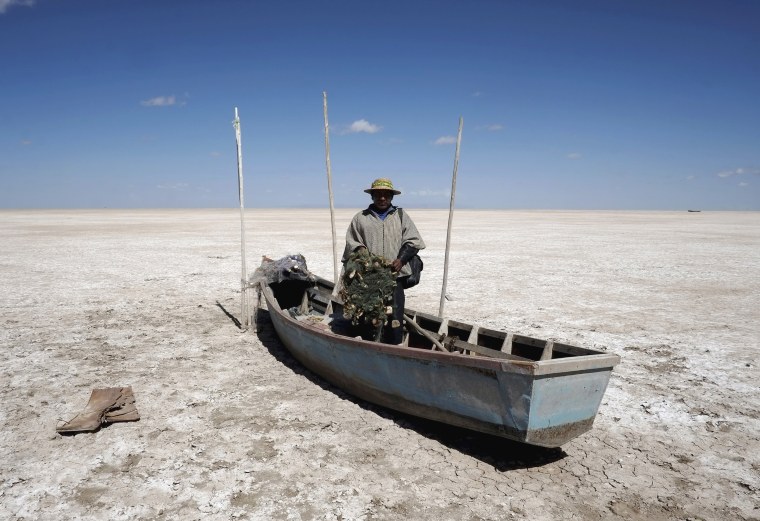
Image: Fisherman Rene Valero, from the Urus ethnic group, is seen on his boat on the dried Poopo lakebed in the Oruro Department, south of La Paz, BoliviaThose Bolivian Bishops have a lot to say when it comes to the environment, and Bolivia has been a leading country in fighting for the rights of Mother Earth. Bolivia is feeling the effects of climate change more than we are thus far. One of my kids visited the country and saw the huge mountain lake called Poopo that disappeared in 2015 due to water diversion and disappearing glaciers related to climate change. The lake will probably not replenish itself.

I was happy to see that the Pope and his encyclical writing team addressed the issue of "carbon credits" in paragraph 171. It has never made sense to me that countries could pay a certain amount of money to "remove" so many tonnes of carbon dioxide from the atmosphere -- after the fact. If I fly to Tahiti and buy a carbon offset so that I can feel better about "dealing with" the greenhouse gas emissions caused by my tropical vacation, someone might plant a tree somewhere with that offset money, but it will take years for that tree to actually remove my emissions. It would be better not to fly at all... and maybe I need to be more serious about how I'm creating greenhouse gases from the beginning. That sacrifice I was talking about earlier.

Unfortunately, so far no one seems to be willing to sacrifice jet setting vacations. While I applaud people who do what they can to offset their air travel -- I'm not saying that carbon offsets are bad -- we also need to reconsider frivolous things like flying to warm places in the winter. And our big, polluting corporations need to stop polluting instead of buying carbon credits from developing countries that don't produce large amounts of greenhouse gases. The idea is to reduce our greenhouse gases and improve the health of our atmosphere, not just to maintain things at the present level of pollution!

Paragraph 172 references the difficulties faced by poor countries and the help they will need from wealthier nations to develop less polluting forms of energy production. It also contains the encyclical's first mention of solar energy as a solution, noting that
Taking advantage of abundant solar energy will require the establishment of mechanisms and subsidies which allow developing countries access to technology transfer, technical assistance and financial resources, but in a way which respects their concrete situations, since the compatibility of [infrastructures] with the context for which they have been designed is not always adequately assessed (Pontifical Council for Justice and Peace, Energy, Justice and Peace, IV, 1, Vatican City (2014), 53.)
I am underlining and bolding the statement that follows the above comment: "The costs of this would be low, compared to the risks of climate change."

It seems to me that, here in North America, we are too afraid to change, to take on our greater responsibility as people who live in countries that contribute the most to climate change. We think it will be too expensive, or too difficult, but in reality, climate change will be more expensive, and more deadly.

We're especially concerned about our livelihoods here in Alberta, where fossil fuel extraction and related industries have been our main employer for fifty years. But if we really think about it, fossil fuels are a dead end because our great-great-grandchildren can't live on a planet choked with greenhouse gases and terrorized by catastrophic events caused by an unstable climate.

We need to change now.

This makes me think of a young man who used to work in the Oil Sands near Fort McMurray. Paul saw that the future for highly polluting chemical processes to extract bitumen from the sand, water and clay up north was taking our environment downhill, fast. So he pulled the plug on that career and retrained to install solar panels. Rather than adding to climate change through his livelihood, he's participating in less polluting work in the alternate energy field and improving the earth's health, long term.

And more of us need to think this way. How can we change and find better ways to deal with the pollution created by our lives? How can we reduce waste? How can we save energy? How can we in North America, who have created greater greenhouse gas emissions with our larger homes, multiple vehicles, and excessive possessions, shoulder our greater responsibility for providing a solution to the problems our lifestyles have caused the planet?

What is one right thing we can do in the week ahead? Or one change we can make? Can we add to the grace of God's creation?

We found a way to help the ozone layer. Now we need to live in grace with the rest of our beautiful planet.

Saturday, March 10, 2018

Sunday Reflection: Accepting God's invitation

Today's reflection is brought to you by
Ephesians 2: 4-10.

O God,
your mercy
is worth more than all our wealth.

Your love
is our life.

Your grace
is our salvation.

You seat us with Christ
to show us
that we are your valued children too.

And nothing we can do,
none of our efforts
to deserve your love
or win our place at your table
are necessary.

It is all your gift
and none of our effort
that brings us to your dwelling place.

All we have to do
is believe in our beloved-ness
and your tenderness
and accept your invitation
to participate in the good work
you have called us to do.

Thank you,
Lover of us all.

+Amen

Friday, May 29, 2015

Some Friday Flamenco

In my next life, I want to be a Spanish lady and dance Flamenco. It's just incredible to me. My dearest friend lived in Spain for a time, and took lessons, and the whole idea of learning that fancy footwork blows my mind.

Even to be able to play flamenco guitar would be astounding!! Here's a beautiful video -- with the passion, emotion and grace of the dance, not to mention the music. A perfect way to end the week, in my books... I'm stomping my feet in my kitchen!


Wednesday, January 28, 2015

From conflict to grace

It's been a very interesting week for moodling. Not that I've done much here, online, but I've been doing a lot while dog-walking, crocheting, and working. I'm spending a fair bit of time these days writing up an interview I conducted for the history of L'Arche Edmonton, one that was particularly painful because it encompassed a time of conflict and gossip in the community.

The thing is, the people involved at that time were all really good people, doing what they felt was best for the community at that moment. But human egos got in the way, and in protecting those egos, it became easy to act less than charitably. We humans are a funny breed -- we so easily convince ourselves that what we do, we do for others, not ourselves, and sometimes don't see that for the power trip it can become.

That's where it can be helpful to have a wise and impartial third party come in and offer an outside perspective, but only if that party's suggestions are carried out. In the portion of the L'Arche history that I am working on, the mediators weren't heard, and for many people, the hurt continues, its tentacles sometimes touching into what happens here and now. Time doesn't necessarily heal all wounds.

I wish I could heal it all, but I'm not God. All I can do is moodle and pray about it, and try to learn from it in my own, human, limited way. The biggest thing, perhaps, is seeing and admitting my own mistakes and foibles, asking forgiveness when I am wrong, and working to make things right again. Then grace has a chance to take hold.

Of course, every bit of grace costs some ego! I guess that's why international conflicts are so difficult to solve -- so many egos are involved. I'm thinking in particular of my fellow blogger, Debbie, and her husband Dean, ecumenical accompaniers in East Jerusalem. You can find Debbie's writing by clicking here. And if you have time, maybe you can send a note to your politicians regarding a just end to the Israeli-Palestinian conflict. That's on my list of to-do's for today.

There was a small conflict in my house last night that needed to be brought to grace, and I was one of the instigators, so I had to ask forgiveness of everyone involved, and work things out. Maybe, just maybe, I'm getting better at seeing my own sins and mistakes more clearly as I get older, but I still have a long way to go to get to grace, full-time.

How about you?

Sunday, August 4, 2013

A beautiful thought for a Sunday


The grace of God means something like: Here is your life. You might never have been, but you are because the party wouldn't have been complete without you. Here is the world. Beautiful and terrible things will happen. Don't be afraid. I am with you. Nothing can ever separate us. It's for you I created the universe. I love you. There's only one catch. Like any other gift, the gift of grace can be yours only if you'll reach out and take it. Maybe being able to reach out and take it is a gift too.

-- Frederick Buechner