What if you were given a superpower that would allow you to design a new society? What would your blueprint look like? What would you keep from our present way of life? What would be unnecessary? What would you add?
There's so much dysfunction in our present existence (especially the US election news these days!) that it sometimes looks like the dystopian novels my young adults read. From the disintegration of families to the breakdown of the environment, the polarization in politics to the rampant over-consumption of our earth's resources -- the hectic and harried pace of society as we know it has dragged us further and further from being soulful people who value life in all its forms. You'd think we could come up with a better plan, no?
Lucky for us, Mark A. Burch has written his own alternate society in his new novel, Euterra Rising: The Last Utopia, which is being released this week. It's a fascinating story of the beginning of something better than life as we presently know it, a renovated existence where people pull together, where everyone has enough, where humans cooperate with nature, and where beauty is appreciated and cultivated daily. I was fortunate to read early drafts of the story, and my initial response to Mark was, "Where is this place? I'll be there in a heartbeat!"
Of course, Mark's view of a simpler world is one that has resonated with me ever since I attended a workshop he gave on Voluntary Simplicity and Personal Wellness, ten years ago this month. He was kind enough to stay in touch because his workshop filled me with many questions, and thanks to the emails that flew back and forth between us, a deep friendship formed. Mark's desire for a world less focused on the material and more in tune with the values of simplicity and sufficiency will always ring true for people who give serious consideration to life's true purpose.
Besides being a wise man in the areas of simplicity and sustainability, Mark is also an excellent writer, having been published many times. It's not easy to pen a good novel that teaches without being overly preachy, but there's an abundance of fresh ideas and suspense in Euterra Rising: The Last Utopia to carry the reader through to the story's end. Chapters begin with wisdom sayings that seem to come from sages beyond our time. The establishment of Euterra is juxtaposed with its later existence and the arrival of an "outsider" whose appearance threatens the community's existence, making for a real page turner. And the bonus is that there's another book in the works, if readers want more!
I would love to see this book become a best-seller, simply because it carries the seeds for many long-overdue conversations about the kind of world we really want to inhabit. We're used to the status quo, to feeling like we have no choice but to go with the flow, but it's past time that we begin to envision and build a better future than the one that's coming down the pipe whether we want it or not. Euterra Rising: The Last Utopia is available via Kindle or in hard copy, with the possibility that Euterra book clubs could be the launch pad for a better world (book club resources are available on Mark's website).
For more information, see http://markaburch.ca/, or visit Euterra on Facebook and meet Nota Dorne, one of the book's characters.
Better yet, pick up the book for yourself, share it with friends, and start imagining and creating the world you really want to inhabit...
Simple Moodlings \'sim-pѳl 'mϋd-ѳl-ings\ n: 1. modest meanderings of the mind about living simply and with less ecological impact; 2. "long, inefficient, happy idling, dawdling and puttering" (Brenda Ueland) of the written kind; 3. spiritual odds and ends inspired by life, scripture, and the thoughts of others
Showing posts with label Mark A. Burch. Show all posts
Tuesday, November 1, 2016
Thursday, November 14, 2013
Simple Suggestion # 186... Meet my friend, Mark
Mark A. Burch is one of the reasons that Simple Moodlings exists at all. I met Mark in 2007 at a workshop he led on Voluntary Simplicity and Nonviolence. It was a weekend that changed my life -- and it led to an amazing and valuable friendship.
Mark is a Voluntary Simplicity expert from Winnipeg, Manitoba. What that means is that he's a man who has thought deeply about life and figured things out. He's come to the conclusion that the complexity of consumer culture and its determination that we all buy, Buy, BUY is killing us and our planet. He experimented with living off-grid, but decided that there had to be a sustainable way to live within our urban settings. He's written several books about re-imagining our world in a way that builds a healthier way of life through simplicity, self-reliance, sharing, co-operation, and community. Retired from the University of Winnipeg, where he used to teach Voluntary Simplicity courses to young adults, he still leads many workshops and sessions on the topic.
Mark is my go-to guy when I have questions about living more simply and sustainably, simply because he's made the time to think everything through. He's also been a major support when I'm feeling overwhelmed by the bad news stories for our environment. His efforts have also introduced me to many others who are on the same journey into simplicity. It's an uphill battle, but it's only better with a friend like him.
My friend has come out with a new book that I intend to buy (it's not in the libraries yet, though I may donate my copy to my local library once I've read it...) because it's bound to inspire me to deepen my practice of Voluntary Simplicity (kind of like Hurricane Haiyan has underlined for me the necessity to have a smaller impact on our planet and thus not contribute to further superstorms...)
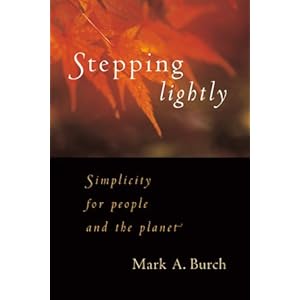
And so... I'd like to introduce you to my friend, Mark, via his two books. Stepping Lightly is a book I refer to frequently -- and I'm really looking forward to reading his latest, The Hidden Door.
Meet my dear friend, Mark... and realize, as he does, that life and everything in it is a gift rather than something to which we are entitled...
Mark is my go-to guy when I have questions about living more simply and sustainably, simply because he's made the time to think everything through. He's also been a major support when I'm feeling overwhelmed by the bad news stories for our environment. His efforts have also introduced me to many others who are on the same journey into simplicity. It's an uphill battle, but it's only better with a friend like him.
My friend has come out with a new book that I intend to buy (it's not in the libraries yet, though I may donate my copy to my local library once I've read it...) because it's bound to inspire me to deepen my practice of Voluntary Simplicity (kind of like Hurricane Haiyan has underlined for me the necessity to have a smaller impact on our planet and thus not contribute to further superstorms...)
And so... I'd like to introduce you to my friend, Mark, via his two books. Stepping Lightly is a book I refer to frequently -- and I'm really looking forward to reading his latest, The Hidden Door.
Meet my dear friend, Mark... and realize, as he does, that life and everything in it is a gift rather than something to which we are entitled...
Tuesday, September 18, 2012
Simple Suggestion #137... Learn more about Voluntary Simplicity
When it comes to explaining Voluntary Simplicity to people, I often find myself tongue-tied just because there's so much to say! You would think that the idea of living simply would be easy to explain, but as it touches every corner of our lives, it takes some doing. It probably shouldn't really need explaining except we're so used to living in a complicated world that half the time we need someone to point out how ridiculously complex everything has become -- to our detriment!
So today's suggestion is one that can open up whole new worlds in us -- spaces where we realize that everything in our lives can be worked so that we live more lightly on the planet and help the earth and ourselves to become happier and healthier in the process. And there are many ways to learn more -- in our libraries and online.
Mark Burch, my Voluntary Simplicity expert/friend in Winnipeg, recently published some of his work through a website called The Simplicity Collective in Australia. It's a pretty neat website, and the material there is free, and paperless! If you'd rather have writings on simplicity in "hardcopy" without running the risk of cluttering shelves, libraries and interlibrary loans are a good way to go. Or if you're looking to own a reference copy of a good book like the one pictured above, Abebooks is a wonderful, online, secondhand bookstore.
In looking at The Simplicity Collective's Website, I realize that there's so much more I could be doing with Simple Moodlings as far as directing people to great Simplicity resources, but life is full enough without my spending more hours at the computer. So I'll add the Simplicity Collective to my sidebar, too, and call it good, as I have plenty of good garden resources that still need to be harvested and preserved over the next few weeks. Now, off to the beet patch...
Looking for more Simple Suggestions? Try here.
So today's suggestion is one that can open up whole new worlds in us -- spaces where we realize that everything in our lives can be worked so that we live more lightly on the planet and help the earth and ourselves to become happier and healthier in the process. And there are many ways to learn more -- in our libraries and online.
Mark Burch, my Voluntary Simplicity expert/friend in Winnipeg, recently published some of his work through a website called The Simplicity Collective in Australia. It's a pretty neat website, and the material there is free, and paperless! If you'd rather have writings on simplicity in "hardcopy" without running the risk of cluttering shelves, libraries and interlibrary loans are a good way to go. Or if you're looking to own a reference copy of a good book like the one pictured above, Abebooks is a wonderful, online, secondhand bookstore.
In looking at The Simplicity Collective's Website, I realize that there's so much more I could be doing with Simple Moodlings as far as directing people to great Simplicity resources, but life is full enough without my spending more hours at the computer. So I'll add the Simplicity Collective to my sidebar, too, and call it good, as I have plenty of good garden resources that still need to be harvested and preserved over the next few weeks. Now, off to the beet patch...
Looking for more Simple Suggestions? Try here.
Monday, December 20, 2010
Making space for Christmas
Recently, my youngest daughter came to me saying, "Mom, you know what I'd like for Christmas? I'd like you to help me clean up my room."
Julia "cleans up" her room on a semi-regular basis, but it often takes her an entire day because she gets caught up in the stuff on her desk and ends up doing art projects or reading forgotten books or playing with little toys she hasn't seen in a while. I was the same way when I was young... but my room wasn't as big, and I don't think I had quite so much stuff.
Usually I leave Julia to fend for herself when it comes to tidying her space. But today is the day WE are going to dejunk, clutter-bust, and clean Julia's room. Here's what we'll need to do it:
1. a garbage bag
2. a bag for recyclable materials
3. a charity box (Julia doesn't mind giving stuff to the Society of St. Vincent de Paul because she knows other children might like the things she's outgrown)
4. a box for items Julia is unwilling to part with, and
5. a box for items which she isn't sure how to categorize.
It then becomes a fairly simple matter to decide where items belong. The only trick is to get the work done rather than playing, reading, or doing arts and crafts for someone's Christmas gift! When the room is clean, we toss the garbage, put the recycling out in our blue bag, take the charity box to SSVP, put away the items Julia is keeping, and the stuff that is in the last box gets put on a shelf in the basement for a year. If Julia "needs" anything from that box, she can retrieve it, and in a year's time, we'll give whatever is in it away.
Since reading Mark A. Burch's little book, De-Junking: A Tool for Clutter-Busting (2007, Simplicity Practice and Resource Centre, ISBN 978-0-9784528-3-4) -- see the sidebar -- this is how I go about cleaning house when I'm in serious dejunking mode. It's a simple plan, and it increases everyone's free time and space. Julia is happier when her desk is clear and she has space to work, and I'm happier when I don't have to nag her about her mess. Part of Christmas preparation is making sure there's "room at the inn," and now's the time to do it!
Julia "cleans up" her room on a semi-regular basis, but it often takes her an entire day because she gets caught up in the stuff on her desk and ends up doing art projects or reading forgotten books or playing with little toys she hasn't seen in a while. I was the same way when I was young... but my room wasn't as big, and I don't think I had quite so much stuff.
Usually I leave Julia to fend for herself when it comes to tidying her space. But today is the day WE are going to dejunk, clutter-bust, and clean Julia's room. Here's what we'll need to do it:
1. a garbage bag
2. a bag for recyclable materials
3. a charity box (Julia doesn't mind giving stuff to the Society of St. Vincent de Paul because she knows other children might like the things she's outgrown)
4. a box for items Julia is unwilling to part with, and
5. a box for items which she isn't sure how to categorize.
It then becomes a fairly simple matter to decide where items belong. The only trick is to get the work done rather than playing, reading, or doing arts and crafts for someone's Christmas gift! When the room is clean, we toss the garbage, put the recycling out in our blue bag, take the charity box to SSVP, put away the items Julia is keeping, and the stuff that is in the last box gets put on a shelf in the basement for a year. If Julia "needs" anything from that box, she can retrieve it, and in a year's time, we'll give whatever is in it away.
Since reading Mark A. Burch's little book, De-Junking: A Tool for Clutter-Busting (2007, Simplicity Practice and Resource Centre, ISBN 978-0-9784528-3-4) -- see the sidebar -- this is how I go about cleaning house when I'm in serious dejunking mode. It's a simple plan, and it increases everyone's free time and space. Julia is happier when her desk is clear and she has space to work, and I'm happier when I don't have to nag her about her mess. Part of Christmas preparation is making sure there's "room at the inn," and now's the time to do it!
Thursday, November 4, 2010
Simple pleasures... and fair trade chocolate
This week is my husband's birthday, so I made chocolate chip cookies. Homemade chocolate chip cookies at our house are fairly rare and rather expensive, because I've given up on the usual chocolate chips you buy at any grocery store. The company that produces them buys cocoa without caring about anything but passing on low prices to consumers. The only way I can be sure that human trafficking, civil war and child slavery aren't ingredients in my cookies is by buying fair trade chocolate chips, which are usually at least four to six times more expensive than the other kind.
Up to five years ago, I was an oblivious chocolate lover, never giving a thought to labour practices in equatorial countries that produce cocoa. But as Carol Off, CBC journalist and author of Bitter Chocolate: Investigating the Dark Side of the World's Most Seductive Sweet (2006, Random House Canada, ISBN 0679313192) says, "as consumers, what we want is cheap goods. But what we should know is that when we consume something that is cheap, generally someone is paying for it someplace else. That's the message about chocolate."
When Lee and I attended Mark A. Burch's workshop on Voluntary Simplicity and Nonviolence the year before Carol's book came out, my eyes were opened to many things I really didn't want to see. When I heard about children -- the same age as my girls -- addicted to drugs and forced to work on chocolate plantations to the point of exhaustion and death, I almost cried. That and many other violences built into our consumer culture made the weekend workshop tough to take in, and I carried the grief and guilt twins around for about a week afterward. But as Mark says, guilt is only good for about ten seconds, and then you have to do something with it. So I did my own research and made a lot of changes, one being that I began to buy fair trade certified chocolate whenever it could be found.
The cost of fair trade is what chocolate really should cost in terms of paying its producers an equitable wage for what they do. Fair Trade also means, usually, that farmers employ more organic methods to grow cocoa berries, leaving soil, air and water in better condition than non-organic growers do.
Chocolate used to be a luxury afforded only by the wealthy on a regular basis. And when you pay the price for fair trade chocolate ($19.75/kg at Earth's General Store), it becomes a precious commodity once again. My girls understand about the problems with cheap chocolate. Suzanna even did a school presentation on it. We've stopped giving out mini-chocolate bar Halloween treats. We never gobble an entire chocolate bar all at once any more. One small piece, savoured and appreciated, is enough. These days, I make ginger snaps, orange shortbreads and oatmeal cookies a lot more often, saving fair trade chocolate chips for special occasions.
I suppose I should also be writing to grocery stores, governments and chocolate giants about refusing sources of tainted chocolate, but then I should also be advocating fair labour practices around almost every item I purchase. It gets overwhelmingly complex when I think about it. But being someone who wants to keep things simple, the simplest thing I can do is vote with my purchasing power, buy fair trade, and share what I've learned with others so they can do likewise. And you can join me!
Up to five years ago, I was an oblivious chocolate lover, never giving a thought to labour practices in equatorial countries that produce cocoa. But as Carol Off, CBC journalist and author of Bitter Chocolate: Investigating the Dark Side of the World's Most Seductive Sweet (2006, Random House Canada, ISBN 0679313192) says, "as consumers, what we want is cheap goods. But what we should know is that when we consume something that is cheap, generally someone is paying for it someplace else. That's the message about chocolate."
When Lee and I attended Mark A. Burch's workshop on Voluntary Simplicity and Nonviolence the year before Carol's book came out, my eyes were opened to many things I really didn't want to see. When I heard about children -- the same age as my girls -- addicted to drugs and forced to work on chocolate plantations to the point of exhaustion and death, I almost cried. That and many other violences built into our consumer culture made the weekend workshop tough to take in, and I carried the grief and guilt twins around for about a week afterward. But as Mark says, guilt is only good for about ten seconds, and then you have to do something with it. So I did my own research and made a lot of changes, one being that I began to buy fair trade certified chocolate whenever it could be found.
The cost of fair trade is what chocolate really should cost in terms of paying its producers an equitable wage for what they do. Fair Trade also means, usually, that farmers employ more organic methods to grow cocoa berries, leaving soil, air and water in better condition than non-organic growers do.
Chocolate used to be a luxury afforded only by the wealthy on a regular basis. And when you pay the price for fair trade chocolate ($19.75/kg at Earth's General Store), it becomes a precious commodity once again. My girls understand about the problems with cheap chocolate. Suzanna even did a school presentation on it. We've stopped giving out mini-chocolate bar Halloween treats. We never gobble an entire chocolate bar all at once any more. One small piece, savoured and appreciated, is enough. These days, I make ginger snaps, orange shortbreads and oatmeal cookies a lot more often, saving fair trade chocolate chips for special occasions.
I suppose I should also be writing to grocery stores, governments and chocolate giants about refusing sources of tainted chocolate, but then I should also be advocating fair labour practices around almost every item I purchase. It gets overwhelmingly complex when I think about it. But being someone who wants to keep things simple, the simplest thing I can do is vote with my purchasing power, buy fair trade, and share what I've learned with others so they can do likewise. And you can join me!
Tuesday, September 21, 2010
Other inspirations
My brilliant husband entered a CBC radio contest last week, and darned if he didn't win! Two tickets to a sold-out event at the University of Alberta, and a book and signing with the presenter/author. I was pretty excited, because the presenter/author is another person who is one of my inspirations.
Dr. David Suzuki was here last night giving his "Legacy Lecture," the lecture that the University of British Columbia "forgot" to ask for when he retired some years ago. Originally a geneticist, but more recently a Canadian TV/radio personality who has made it his business to try to raise awareness about critical ecological issues, he is an excellent speaker who is able to bring vague scientific concepts down to a level where those of us who lack Ph.D.s can understand them.
His "Legacy Lecture" last night was his attempt to share "an elder's wisdom." David is 74, but I found it hard to think of him as an elder because he had so much energy on the stage. After the presentation, however, at the book signing, he looked tired and "elderish." Head down, writing away, not a word to anyone but the woman who was telling him to whom the book was to be dedicated. I'm sure it's hard work to be on the road at 74, ranting at the world about reducing human impact on the planet, leaving its beauty behind for future generations, and slowing down. Having so many people want a piece of you, even if only your signature in a book, must be exhausting. But he carries it off, night after night, his legacy to the world, even as it mostly ignores him.
I first heard David speak back in the late eighties at an Aboriginal Education Conference during my brief teaching career. And he used the same words then as he did last night: "How much is enough?" "Growth for the sake of growth is unsustainable and cancerous." "The economy is not the bottom line; the ecosphere is." I don't think his words ever left me the first time I heard them, but they were blunted during the years that followed as I busily set up my life as an adult -- career, marriage, home, family. I suspect Dr. Suzuki's words were one of the reasons that I fought against a lot of conventional accumulations by doing things like renting a wedding dress, sticking with a single vehicle, having a reasonable-sized home, and attempting to buy non-designer necessities and local foods.
When I met Mark A. Burch in 2005, suddenly "How much is enough?" returned to my life with full force. Mark isn't as famous as David Suzuki, but he should be. Mark should have a blog! (As if a blog makes anyone famous, ha!) Mark introduced us to Voluntary Simplicity, which is a more wholistic version of what David Suzuki has been ranting about for so many years. Because of Mark's workshops, and his friendship, we have learned many ways to reduce our ecological footprint and live in greater harmony with our damaged ecosphere, and have discovered that Voluntary Simplicity provides a more challenging and rewarding way to live. We've cut our consumption/materialism, become more self-reliant and community-minded, and are generally more aware of small things we can do daily to decrease our impact on the planet. Even so, we still have a long way to go...
Now there isn't a day that goes by without me thinking about living more lightly in one way or another. I'm blessed because my life has been one of awe and wonder at the beauty of this world coupled with a sense of it's fragility. This blog is a natural extension of that awe and wonder, and my desire to do something to make things better somehow.
Here are some links if you want to find out more about living lightly:
http://simplicitycentre.org/
http://www.davidsuzuki.org/#
Dr. David Suzuki was here last night giving his "Legacy Lecture," the lecture that the University of British Columbia "forgot" to ask for when he retired some years ago. Originally a geneticist, but more recently a Canadian TV/radio personality who has made it his business to try to raise awareness about critical ecological issues, he is an excellent speaker who is able to bring vague scientific concepts down to a level where those of us who lack Ph.D.s can understand them.
His "Legacy Lecture" last night was his attempt to share "an elder's wisdom." David is 74, but I found it hard to think of him as an elder because he had so much energy on the stage. After the presentation, however, at the book signing, he looked tired and "elderish." Head down, writing away, not a word to anyone but the woman who was telling him to whom the book was to be dedicated. I'm sure it's hard work to be on the road at 74, ranting at the world about reducing human impact on the planet, leaving its beauty behind for future generations, and slowing down. Having so many people want a piece of you, even if only your signature in a book, must be exhausting. But he carries it off, night after night, his legacy to the world, even as it mostly ignores him.
I first heard David speak back in the late eighties at an Aboriginal Education Conference during my brief teaching career. And he used the same words then as he did last night: "How much is enough?" "Growth for the sake of growth is unsustainable and cancerous." "The economy is not the bottom line; the ecosphere is." I don't think his words ever left me the first time I heard them, but they were blunted during the years that followed as I busily set up my life as an adult -- career, marriage, home, family. I suspect Dr. Suzuki's words were one of the reasons that I fought against a lot of conventional accumulations by doing things like renting a wedding dress, sticking with a single vehicle, having a reasonable-sized home, and attempting to buy non-designer necessities and local foods.
When I met Mark A. Burch in 2005, suddenly "How much is enough?" returned to my life with full force. Mark isn't as famous as David Suzuki, but he should be. Mark should have a blog! (As if a blog makes anyone famous, ha!) Mark introduced us to Voluntary Simplicity, which is a more wholistic version of what David Suzuki has been ranting about for so many years. Because of Mark's workshops, and his friendship, we have learned many ways to reduce our ecological footprint and live in greater harmony with our damaged ecosphere, and have discovered that Voluntary Simplicity provides a more challenging and rewarding way to live. We've cut our consumption/materialism, become more self-reliant and community-minded, and are generally more aware of small things we can do daily to decrease our impact on the planet. Even so, we still have a long way to go...
Now there isn't a day that goes by without me thinking about living more lightly in one way or another. I'm blessed because my life has been one of awe and wonder at the beauty of this world coupled with a sense of it's fragility. This blog is a natural extension of that awe and wonder, and my desire to do something to make things better somehow.
Here are some links if you want to find out more about living lightly:
http://simplicitycentre.org/
http://www.davidsuzuki.org/#
Subscribe to:
Posts (Atom)