Showing posts with label water issues. Show all posts

Sunday, March 3, 2019

Laudato Si Sunday Reflection: Seeing rightly, living rightly

Today's reflection is brought to you by
Luke 6:39-45.

You challenge us,
O Christ,
to see rightly.

Our blind spots
to your will in our world
come from our own prejudices.

It is easier
to find fault with others
than to address our own inadequacies.

Known by the fruit we bear,
we must ask ourselves:
where does our treasure lie?

You tell us
that our words and actions
arise from the abundance
of our hearts.

Help us,
O Christ
to let our hearts rest
in the beauty,
goodness and truth
that is you
so that we may increase
your beauty,
goodness and truth
in our world.

Show us how to see rightly
and live rightly.

+Amen

 * * * * * * *

This week's rereading of paragraphs 27-31 of Pope Francis' encyclical letter, Laudato Si: On Care for our Common Home (the entire encyclical can be accessed by clicking here) reminded me of all the water that I take for granted. The Pope and his encyclical writer friends preface their comments on water use by pointing out that "... the habit of wasting and discarding has reached unprecedented levels. The exploitation of the planet has already exceeded acceptable limits and we have still not solved the problem of poverty." (paragraph 27).

Water is one of those things we waste and discard without thinking. It isn't just important, it's essential to life of all kinds -- "terrestrial and aquatic ecosystems" need to be everyone's concern: "Water supplies used to be relatively constant, but now in many places demand exceeds the sustainable supply, with dramatic consequences.... Water poverty especially affects Africa where large sectors of the population have no access to safe drinking water or experience droughts which impede agricultural production." (paragraph 28).

Of course, it's always the poor -- those who lack security, wealth, and political power -- that are most affected, as noted in paragraph 29. In the developing world, they often don't have access to safe water, or have to walk long distances to access it. But even here in a "developed" country like Canada, we still have 60 drinking water advisories on First Nations reserves, though I am happy to note that's down from 132 advisories since I last looked at the website, and 3 of 4 of the advisories in my own Alberta backyard have been resolved. Inadequate water treatment, or pollution of water sources through industrial activity are an issue faced by our marginalized brothers and sisters all over the world. Too often humans are desecrating the fresh water God gives us, which flows and flows until it reaches the oceans, polluting them as well.

To add insult to injury, the poor face inadequate fresh water supplies in some places because large corporations are privatizing and bottling water, selling it at higher prices per litre/gallon than gasoline. Paragraph 30 states that "access to safe drinkable water is a basic and universal human right, since it is essential to human survival and, as such, is a condition for the exercise of other human rights." And yet we in North America continue to use water and buy bottled water as if it is an unlimited resource. Yesterday on my walk with the dog, I picked up two empty plastic bottles, grrrr. (Plastic is one of my pet peeves these days!)

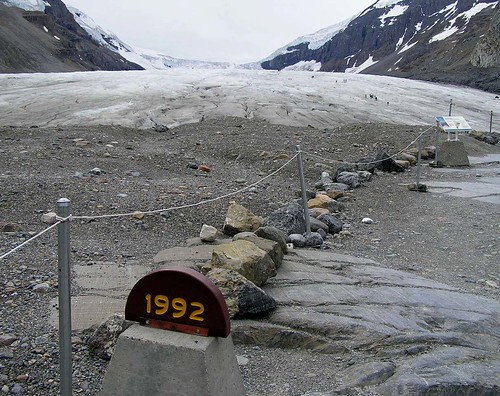
Last summer, Lee and I visited the Athabasca Glacier from which our North Saskatchewan river takes its waters, and this time, there was a good-sized stream flowing off the glacer long before we reached it. Our city depends on water from the Athabasca Icefields. What will happen when they're gone? Global climate change means that some parts of the world are already facing acute water shortages, but still we forget that we can't create glaciers, or rainstorms, or a single water molecule the way God can.

Paragraph 31 points out the possibility of water shortages within a few decades, but our brothers and sisters in Australia, California, South Africa and so many other places know what it is to live with water scarcity. They have already been forced to implement measures to conserve and protect water sources. Fresh water is anything but infinite, and we should all be doing the same.

St. Francis sang the praises of Sister Water, "so useful, humble, precious and pure" in Il Cantico del Sole (Canticle of the Sun), as if she was a person standing right beside him. We would do well to treat water with that kind of love and respect.

So today, I'd like to invite my readers to get themselves a glass, go to the kitchen faucet, and fill it, and reflect on whether we are seeing water rightly -- as an extremely valuable resource -- and using water rightly. Is our water clean and clear? Take a sip and savour. Consider: how much does it cost? How do we take it for granted? How can we use less/pollute it less? Do we use phosphate-free dish soap and laundry soap? Do we remember to carry our own water bottles so that water sources aren't comodified for our convenience? Can we cut down on less critical water use such as lawn watering, sidewalk spraying, and car washing for the sake of the environment? How can we support our brothers and sisters who are affected by water shortages and drinking water advisories?

Do we treat Sister Water with the respect she deserves? Or is there room for improvement? Lord, that we may see.

Saturday, September 5, 2015

Laudato Si: Sunday Reflection #7... What are you made of?

My funny suntanned feet in the icy clear waters of Lake Minnewanka
I'm guessing I'm made up of about 60% water, a whole slew of minerals, with an intellect, some love, and a soul thrown in for good measure. You?

That first ingredient, water, is the topic of paragraphs 27-31 of Pope Francis' encyclical letter, Laudato Si: On Care for our Common Home (the entire encyclical can be accessed by clicking here.) The Pope and his encyclical writer friends preface their comments on water use by pointing out that "... the habit of wasting and discarding has reached unprecedented levels. The exploitation of the planet has already exceeded acceptable limits and we have still not solved the problem of poverty." (paragraph 27).

And water is one of those things we waste and discard without thinking. It isn't just important, it's essential to life of all kinds. The Pope's main focus is on human life, but he doesn't forget "terrestrial and aquatic ecosystems" in his concern: "Water supplies used to be relatively constant, but now in many places demand exceeds the sustainable supply, with dramatic consequences.... Water poverty especially affects Africa where large sectors of the population have no access to safe drinking water or experience droughts which impede agricultural production." (paragraph 28).

Of course, it's always the poor -- those who lack security, wealth, and political power -- that are most affected, as noted in paragraph 29. In the developing world, they often don't have access to safe water, or have to walk long distances to access it. But even here in a "developed" country like Canada, on June 30, 2015, there were 132 drinking water advisories on 92 First Nations reserves, 4 of them ongoing in my own Alberta backyard. Inadequate water treatment, or pollution of water sources through industrial activity are an issue faced by our marginalized brothers and sisters all over the world. Too often humans are desecrating the fresh water God gives us, which flows and flows until it reaches the oceans, polluting them as well.

To add insult to injury, the poor face inadequate fresh water supplies in some places because large corporations are privatizing and bottling water, selling it at higher prices per litre/gallon than gasoline. Paragraph 30 states that "access to safe drinkable water is a basic and universal human right, since it is essential to human survival and, as such, is a condition for the exercise of other human rights." And yet we in North America continue to use water and buy bottled water as if it is an unlimited resource, even during drought times like we in the west experienced this summer. Will suburbanites always think green lawns are critically important? One hopes not!

Every so often, we visit the Athabasca Glacier from which our North Saskatchewan river takes its waters, and every time, I feel anxious as we walk the the stony path that holds markers showing how much it has melted over the years. Global climate change means that some parts of the world are already facing acute water shortages. Water is a gift that we are given. We forget that we can't create glaciers, or rainstorms, or a single molecule the way God can.

Paragraph 31 points out the possibility of water shortages within a few decades, but our brothers and sisters in Australia, Brazil, California and so many other places know what it is to live with water scarcity. They have already been forced to implement measures to conserve and protect water sources. Fresh water is anything but infinite, and we should all be doing the same.

St. Francis sang the praises of Sister Water, "so useful, humble, precious and pure" in Il Cantico del Sole (Canticle of the Sun), as if she was a person standing right beside him. He may have guessed that she is within all of us, a big part of our bodily composition. We would all do well to treat water with the kind of love and respect God wants us to show all of creation.

So today, I'd like to invite my readers to get themselves a glass, go to the kitchen faucet, and fill it. Is it clean and clear? Does it have an odor? Is it drinkable? Take a sip. How much does it cost? How do we take it for granted? How much do we waste or pollute it? How can we pollute it less? Where can we find phosphate-free dish soap and laundry soap? What other kinds of things do we pour down our drains without thinking? How can we remember to carry our own water bottles instead of buying bottled water, so that water sources aren't commodified for our convenience? Can we cut down on lawn watering, sidewalk spraying and car washing for the sake of the environment? How can we support our brothers and sisters who are affected by water shortages?

Do we treat Sister Water with the respect she deserves? Or is there room for improvement?

*******
A prayer for our earth

All-powerful God, you are present in the whole universe
and in the smallest of your creatures.
You embrace with your tenderness all that exists.
Pour out upon us the power of your love,
that we may protect life and beauty.
Fill us with peace, that we may live
as brothers and sisters, harming no one.
O God of the poor,
help us to rescue the abandoned and forgotten of this earth,
so precious in your eyes.
Bring healing to our lives,
that we may protect the world and not prey on it,
that we may sow beauty, not pollution and destruction.
Touch the hearts
of those who look only for gain
at the expense of the poor and the earth.
Teach us to discover the worth of each thing,
to be filled with awe and contemplation,
to recognize that we are profoundly united
with every creature
as we journey towards your infinite light.
We thank you for being with us each day.
Encourage us, we pray, in our struggle
for justice, love and peace.

+AMEN.

(A prayer for our earth and all quotations from Laudato Si: On Care for Our Common Home © Libreria Editrice Vaticana)

Next up: #8... Biodiversity? What's it worth?

Tuesday, January 22, 2013

Simple Suggestion #148... Go natural

This won't be a popular moodling, but I'm not out for popularity. After seeing a hair colour commercial last night that almost made me gag, I'm done with tippy-toeing around this topic. You're getting my real feelings here today. And if you colour your hair, you might not want to know my real feelings, so you've been warned. I guess I've lived long enough that I can be an opinionated woman on certain subjects...

Before I get any further, I'll be honest about my past hypocrisies. I have coloured my hair -- twice. My first grey hairs appeared when I was the tender age of 23. I pulled the two of them out. But then I thought, why be so vain? Greys are a sign of character. I'd always admired salt-and-pepper girls my age. Unfortunately, the that didn't last. Not long after my third child was born, my sisters and I had a girls' party with a box from Clairol. My hair was very salt-and-pepper at that point, so we picked up a rich brown that wouldn't make the change seem too obvious, and, voila, a "new me." (Not really, though that's one line with which marketers make their money.)

Every time I washed my hair during the weeks following, I watched chemical colour run down the drain. Seeing the sullied water bothered me, but as I wasn't too concerned about our environment at that point in my life, I ignored my unease. Years later, when my sister-in-law and I turned forty within two weeks of each other, we went to a snazzy salon in Le Marchand Mansion and spent an outrageous amount of money on colour -- with highlights -- and a cappuccino on the side. My hair never felt so soft and manageable or looked so fantastic, and the salon's coffee service was good, too.

So why do I have issues now with the hair colour industry? Well, for the same reason that I have issues with anything that complicates life, consumer culture in particular. It has a way of manipulating us (and sometimes, those around us) so that we think we need to change just for the sake of change (and for the sake of consumerism's bottom line, but it never mentions that). If I had the time, I could dismantle just about every beauty boon, cosmetic craze, or fashion fad there is, but today I'm picking on hair dye. When a larger portion of the world's women every day are subjecting themselves to unpronounceable chemicals (ever try to read the side of a hair colour box?) in order to spice up their lives by spiffing up their locks, is that really a good thing?

I wish you could meet my dear neighbour, back alley Mary, who died of lung cancer (she was a smoker) in the summer of 2009. She was a funny and delightful woman that I just loved to talk with whenever I saw her. We chatted about everything and anything over our respective fences, shared gardening tips, and she taught me to make pickles, perogies and pie crusts. She was like an extra grandma to my youngest daughter, and overpaid my kids for shovelling her sidewalks. We all loved her and the pies and pizzelli she brought to our back door. You'd be hard pressed to find a better neighbour or friend.

Several times during our over-the-fence chats, Mary commented on my salt-and-pepper hair and how lovely the grey looked. I thanked her, and commented that if she would go natural she'd be even lovelier than she already was. She pulled at her perm- and dye-damaged hair, saying, "Oh, I could never do that. My hair is already white -- see the roots? I'd look so old." And I'd look at her outrageous strawberry blonde or brassy brown with those white roots showing through and think, "Who has done this to you? Who has made you think that white hair isn't beautiful on a 74-year-old?"

We know darn well who has done it. Who can't name several hair dye brands without even trying (men will know Grecian Formula if they watch hockey, right)? We've all seen the commercials featuring stunningly beautiful women with incredibly shiny coloured tresses flowing around them like cascades of riches. The one I finally saw last night (my girls tell me it's been around for a while) featured an adorable Aussie or Kiwi actor saying "Kate's more beautiful now than the day I married her." I have yet to meet a real human being married for 15 years with two kids who has hair that looks like Kate's, and I have yet to see a hair product advertisement with a model who has unevenly greying hair like mine. Of course, marketers won't make much of a living if they encourage people like me to love the hair we have. Their reason for existence is to create artificial needs, so they tell me I should be like Kate perpetually and "wash that grey right out of my hair" until the day I die. Like dear Mary did.

But if you know me by now, you know I'm a rebel who can't stand that kind of conformist blather. The last time I wrote on this topic was in October 2010. Today I went looking for fresh stats, and couldn't find any, which makes me wonder if the hair colour industry doesn't want us to realize how much of our lives' hard work goes toward paying for colour-in-a-box. According to an undated article I found in 2010 on the Marie Claire magazine website, in 2008, 1.6 billion dollars were spent on home hair colour in the US, $490 million in Mexico, $180 million in India, and $400 million in the UK (Canada doesn't register on a New York magazine's radar). Increases in sales of in-home hair colorants from between 29% in the Middle East to almost 180% in the Eastern Bloc countries were reported since 2002. I'd love to have a penny for every dollar we spend now.

Of course, not a word in the article about the chemicals in hair colour, lovely sounding things like 6-Methoxy-2,3-Pyridinediamine, 2,3-Naphthalenediol, N-Cyclopentyl-m-Aminophenol, and Acid Red. Try repeating those 5 times in under a minute. If unpronounceable chemicals with numbers attached don't scare us, just the smell of them combined should. In 2010, the David Suzuki Foundation released a report on some of the toxic substances in our personal care products, and hair dyes were the second thing singled out because some colourant chemicals have the potential to cause cancer, or contain heavy metals that are toxic to the brain.

But let's put concerns about chemicals messing up our bodies aside because nobody believes in them anyway... let's guesstimate... let's just pretend that out of 34.5 million Canadians, a fifth of us (or 6.9 million -- I'll bet that's a modest guess because a lot of guys are into this racket, too) buy six fourteen dollar packages of home hair colour per year (gotta keep up with those roots, right?) to the tune of about $85 dollars a year. That would mean that Canadians spend about $586 million on nearly 42 million do-it-yourself dye jobs per annum. And if we use a modest twenty litres of water to wash the chemicals away each time... that's 840 million litres of dye-polluted water. When you take into account the fact that the average person needs five litres of clean water per day to live in a moderate climate, and you realize that about 780 million of our brothers and sisters in the developing world don't have access to drinkable water (data from http://www.unicef.org/wash/ ), it doesn't take a genius to see that all the good water we waste colouring our hair could go a long way...

If you want to argue with my stats, guesstimation, or math skills, be my guest. I never was very good at those subject areas. But water issues are becoming critical in a lot of places in our world due to climate change, and the needless use of chemicals contributes to the pollution of land, air, oceans, and us. Do we need to dye our hair? Do we have to buy personal care/beauty products that contain toxins? Must we follow fashion trends? Or is there any way, any way at all, that we can live more simply?

Going natural is one way. I have a deep respect for those women in my life who have never felt the need to colour their hair, but who accept themselves as they are and take aging as it comes, with grace and humility. They're the ones who inspired me to post the video below a few years back (excuse the poor sound quality -- I don't actually have a lisp), and since then, several other friends have joined me in living more simply in this regard. If it inspires you, or you want a copy of my poem to share with friends, my email address is under "profile" on the sidebar, and I'm happy to share, especially if it gives others the "permission" they need to truly be themselves.

Naturals of the World, Unite! And share the news with all our "dyeing" sisters and brothers -- free them from the idea that they have to hide those greys or improve their tresses at the expense of their health or our world's diminishing freshwater supply... because today's suggestion to go natural is just another small step we can take to make the world a better place.


P.S. Looking for more Simple Suggestions? Try here.

Tuesday, March 22, 2011

International Water Day

How much water do you use in a day? That question has been on my mind ever since I posted that little National Geo video about the typical human being (Sunday, I think it was). When I woke up this morning, the radio host announced that it's International Water Day... so perhaps now is a good time to moodle about water issues.

Ever since Lee and I attended a workshop on Water and Sustainability at an Ideas Symposium a few years back, I've been trying to cut back on my personal water usage. I used to shower every day, but now it's every other day (or longer, and my skin has never been healthier, go figure). As a family, we've adopted the "If it's yellow, let it mellow..." rule in the bathroom (except when guests are present). Our dishwasher never operates unless it's full, we've got low-flush toilets, low-flow showerheads, and a front load washer that uses so little water (in comparison with the old top-load kind) it amazes me. Our kids know better than to leave the water running while brushing their teeth, and we've seen a general decrease in our water usage bills over time. Outdoors, we use rain barrel water most of the time and our lawn doesn't get watered (we're in the process of getting rid of it altogether), but our vegetables do.

Even with all these water conservation strategies, I'm still thinking about those women of Ethiopia in the National Geo video who use 2.5 litres of water per day, and spend 8 hours gathering it. I suspect some of us use that much to wash our faces in the morning, without considering the fact that water shortages in various places around the globe mean a lot of our brothers and sisters have to struggle to survive. In some cases, those brothers and sisters live where there is plenty of water... but big beverage companies have bought water "rights" out from under them so that we in the developed world can drink exotic bottled water.

A few years ago, Development and Peace (see Favourite Links on the sidebar) made water rights one of its main causes. During Lent, there was a big campaign to try to bring awareness of water issues to the public, and to discourage the drinking of bottled water. They gave out these lovely little "Bottled Water Free Zone" window stickers to people who committed themselves to not using those too-handy convenience store items. If you really think about it, it's silly to pay more for a litre of water than we do for a litre of gas... And do you remember the scandal when it was discovered that the Dasani brand of bottled actually came from taps in Calgary?

Unfortunately, a lot of people are willing to pay for the convenience of water at your fingertips (or in a flat in the trunk of your car), but I'm not. My youngest daughter learned a while back that either she goes thirsty or she packs her own water bottle when we go out, because Mom will not break down and buy one no matter how much whining occurs. I just can't, especially when I think about what it would feel like to have to walk long distances to get water for cooking, cleaning and washing because some bottled water baron won't let you have access to your local stream, and when I consider the mountains of plastic bottles that people buy and toss. True, in many places there are wonderful recycling facilities, but wouldn't it make more sense to fill a reusable water bottle at home or elsewhere instead of using more energy turning plastic bottles into plastic lumber, staticky polar fleece clothing, and whatever other usages they've invented? (The overuse of plastic polymers in a world that is running out of fossil fuels is another moodling topic for another day.)

I could go on and on, but the point is that many of the world's water resources have been polluted or overused, they're not turning out to be as renewable as we imagined, and with almost seven billion of us on the planet, it wouldn't hurt to use a lot less (not just water -- a lot less of everything). With our glaciers melting at an alarming rate, not to mention the steady disappearance of our polar icecaps and the weather changes that is causing, we need to reexamine our relationship with water. This morning, the radio station I wake up to aired a story about a woman who is taking a challenge to live on a very little water...  30 litres, if I was actually awake when I heard that story. If I can find a podcast link, I'll post it. In the meantime, I think I'll shorten my showers and look for other ways to conserve. I haven't given much thought to grey water usage yet...

(10: 30 p.m. Didn't find the podcast, but here's a link to another fellow who just completed the 25 litre challenge. http://ontario.sierraclub.ca/en/blog/73 James Hutt is a member of the Sierra Club in Ontario who can tell you a lot about water issues and the need to conserve a pretty precious natural resource from an environmental perspective. For me, it's also an issue of using less to be in solidarity with those who have less.)

Thursday, October 21, 2010

Hair: Natural or Not?

I'm not talking the musical from the sixties. (But did you know its full title is Hair: The American Tribal Love-Rock Musical? I didn't!) I'm talking hair enhancement, so if you love to colour or otherwise enhance your hair, you might want to skip this moodling. Really.

My beautiful sixteen year old daughter came home from a friend's house with her lovely brown hair a fresh auburn colour two weeks ago. It's not the first time she's coloured her hair. Two years ago, she went for pink highlights, and she was auburn this spring, but it grew out. The colour looks wonderful on her, actually. I do like it. But something is really messed up when gorgeous teenage girls think that their hair is boring and they need to do something to change it.

I'll be the first to admit it -- I have coloured my hair in the past. My sisters and I had an evening with a box from Clairol not long after my third daughter was born. My hair was already greying at that point, so we picked up a rich brown (the ingredients of which I never thought to question) of non-permanent colour and, voila, a new me. Every time I washed my hair that week, I watched colour run down the drain. Years later, when my sister-in-law and I turned forty within two weeks of each other, we went to a snazzy salon and spent an outrageous amount of money on permanent colour -- with highlights. My hair never felt so soft or looked so fantastic.

So why do I have issues with the hair colour industry? Well, for the same reason that I have issues with anything that complicates life, like the cosmetics/beauty/fashion industries. They have a way of manipulating us so that we think we need to change just for the sake of change (and for the sake of their bottom line, but they don't mention that).  If I had the time, I could tear into just about every cosmetic craze, fashion fad or beauty boon that is recommended, but today I'm choosing hair dye. When a larger portion of the world's women every day are subjecting themselves to unpronounceable chemicals (ever try to read the side of a hair colour box?) in order to spice up their lives by spiffing up their locks, it can't be good.

I wish you could meet my dear neighbour, back alley Mary. She was a funny and delightful woman that I just loved to talk with whenever I saw her. We chatted about everything and anything over our respective fences, shared gardening tips, and she taught me to make pickles, perogies and pie crusts. She was like an extra grandma to my youngest daughter, and overpaid my kids for shovelling her sidewalks. We all loved her. You'd be hard pressed to find a better neighbour or friend.

Several times during all those over-the-fence chats, Mary commented on my salt-and-pepper hair and how lovely the grey looked. I thanked her, and commented that if she would go natural she'd be even lovelier than she already was. She'd pull at her dye- and perm-frizzed hair, saying, "Oh, I could never do that. My hair is already white -- see the roots? I'd look so old." And I'd look at her outrageous strawberry blonde or brassy brown with those white roots showing through and think, "Who has done this to you? Who has made you think that white hair isn't beautiful on a 74-year-old?"

We know darn well who has done it. Who can't name several hair dye brands without even thinking about it? We've all seen commercials featuring stunningly beautiful women with incredibly shiny (read: shellacked) coloured tresses flowing around them like cascades of riches. I have yet to meet a real human being with hair that looks like that, and I have yet to see an advertisment with a model who has unevenly greying hair like my friend Charleen's, or like mine. (I don't get the Grey Power magazine -- yet.)

According to Marie Claire Magazine (I looked up "International Hair Colour Trends" and found an undated article on the magazine website), in 2008, 1.6 billion dollars were spent on home hair colour in the US, $490 million in Mexico, $180 million in India, and $400 million in the UK (I guess Canada doesn't register on Marie Claire's radar). Increases in sales of in-home hair colorants from between 29% in the Middle East to almost 180% in the Eastern Bloc countries were reported since 2002.

Not a word in the article about chemicals in hair colour, but this week the David Suzuki Foundation (right sidebar under my Favourite Links) released a report on the toxic substances in our personal care products -- wanna bet there are more than a few in those dyes? Anyway... let's guesstimate... let's just pretend that out of 33 million Canadians, a fifth of us (I'll bet that's a good guess) buy six twelve dollar packages of home hair colour per year (gotta keep up with those roots, right?) to the tune of $72 dollars a year. That would mean Canadians spend about $475 million on do-it-yourself dye jobs. Add it with those other figures in the previous paragraph from 2008, and we're up to over three billion dollars spent on colour-in-a-box (and that doesn't include Europe, Australia, Africa, or Asia). Divide by $12, and we're talking two hundred and fifty million home hair colour jobs and all the chemicals they entail. And if every person uses a modest twenty litres of water to wash the chemicals away... that's five billion litres of polluted water. When you take into account the fact that the average person needs five litres of clean water per day to live in a moderate climate, and you realize that 1.2 billion people in the developing world don't have access to clean water (data from  http://www.worldwater.org/ ), it doesn't take a genius to see that all the good water we waste colouring our hair could go a long way...

If you want to argue with my guesstimation or my math skills, be my guest. I never was very good at either. But water issues are becoming critical in a lot of places in our world due to climate change, and needless use of chemicals contributes to the pollution of land, air, oceans, and us. Do we need to dye our hair? Do we have to buy personal care/beauty products that contain toxins? Must we get rid of the clothes in our closets when they're no longer in style? Or is there any way, any way at all we can live more simply?

I moodle today in memory of my friend Mary. I love seeing peoples' true colours, and I never got to see hers before she died of cancer last summer.