Showing posts with label healing relationships. Show all posts

Tuesday, February 5, 2019

Blankets for reconciliation and solidarity

The Society of St. Vincent de Paul collected
6 large bags of blanket for those in need
at the end of our exercise
On Sunday, the conference of the Society of St. Vincent de Paul in our twin parishes sponsored a Blanket Exercise. Our work with those in need in our area brings us into contact with many Original Peoples who live in our part of Edmonton. We held the event to try to bring more education and awareness about how they have been impacted by the actions of those who "settled" North America, and the government policies that take advantage of them by frequently changing the rules of relationship.

The Blanket Exercise was facilitated by five volunteers from RISE -- Reconciliation in Solidarity Edmonton. About thirty people gathered to walk through Canadian history as experienced by the Original Peoples of Canada. We spread blankets on the floor to represent the land, and all of us who stood together on the blankets represented Inuit, Metis, and First Nations people who lived on the land before colonialism. One facilitator narrated the exercise, while another represented the Europeans who came to Canada beginning in the early 1600s.

Each one of us represented a 'sovereign nation' at the beginning of the exercise, and we mixed and
The beginning of the exercise
mingled, trading and exchanging with other 'sovereign nations.' When Europeans came, we shared knowledge with them, helping them to survive our harsh winters and discover the abundance of wildlife and food sources in a new land. But the newcomers brought smallpox, which killed many (I 'died' only 5 minutes into the exercise).

Soon European settlers began over-hunting and trapping some animals to near extinction, sending the land's wealth to their countries across the oceans. It wasn't long before they were calling Original peoples 'uncivilized' and changing the rules of their treaties so that all land not being used for 'civilized' purposes belonged to them. And when Inuit, Metis and First Nations children were taken from their homes and families to be 'civilized' in Residential Schools, whole generations lost their family ties, sense of culture, and self worth. Those who survive often find themselves pushed to the margins of Canadian life, though there are many strong people among them working to improve things.

I am not of First Nations descent -- I am a grandchild of European settlers, as were many of the other participants. So this journey through history according to how First Nations people experienced it was more than eye-opening for those of us who had not heard this version of history (school curricula are changing, thank heavens). The word 'civilize' took on very negative connotations in a hurry, a near equivalent of 'exploit,' and becoming more aware of some of the many injustices that have been dealt to the Original Peoples was extremely sobering for our group. We became aware of the many deep hurts from which they are still recovering. I can't help but feel that they are much stronger than I could ever be because they have been through so much.

The end of the exercise
I grew up in a small Saskatchewan town where my best friend was a girl who had been taken from her family on Thunderchild Reserve at the age of three and given to a foster family. No one had heard of the Sixties Scoop back then, and Noreen and her five-year-old sister, Eileen, were too little to understand or protest being taken away from their parents and siblings. Of course, I had no idea about the hurts of living with her foster family, either. All I knew was that Noreen was a wonderful and creative friend with a great sense of humour, and we explored our prairie home together and played many imaginative games. I loved her like an older sister and had no idea that my home was a place of refuge for her.

When my family moved to Edmonton, I was bereft because I lost my best friend, and so was she, because her safe space was gone. Unfortunately, Noreen was not a letter writer, and we lost contact. I found myself on the lookout for another best friend like her -- but there was no one like her. All the kids I met in my new school were as caucasian as I was, and it wasn't until I reached Grade Seven that the first First Nations girl appeared in my grade. She was more interested in teasing the boys than in being my friend, and I missed Noreen more than ever.

Years later, I became an elementary school teacher in the town of Ponoka, just down the road from the Sampson Cree Nation. I was delighted to have five First Nations children in my first grade four class, and others in the following years. They couldn't help but be my favourites because they so often reminded me of my first best friend -- their surprising wit and creative thinking delighted me to no end. Aware that many of them came from challenging family situations, I did all that I could to make school an enjoyable experience where their gifts and talents were celebrated. And two months ago, I was thrilled when one of those students found me on Facebook thirty years later and re-established our relationship. I've also managed to reconnect with Noreen via Facebook, and it has been really wonderful to share our lives in middle age!

Of course, these friends have underlined for me the white privilege in which I was born, raised and lived all these years. Neither Noreen nor my former student have had it easy, dealing with addictions, family violence, suicides, and many other challenges that are direct results of inter-generational trauma. Our First Nations sisters and brothers have many reasons to resent all the non-original peoples who have come to Canada over the last 400 years.

I was very grateful for our Blanket Exercise participant who was from the Beaver Cree Nation. As our only First Nations participant, he was able to speak about his experience and share some of the injustices that were and still are inflicted on his family. He mentioned that one of his hurtful memories was when someone said to him, "Don't play the Indian card with me." How many descendants of Europeans are singled out like that these days? His comment gave us all pause for thought.

Our prejudice, and our blind support of the systems that create forms of trauma our Original Peoples are still experiencing -- because of prejudice, being forced to live in substandard housing on reserves, or being mistreated at residential schools, to name only three of many issues -- are things that we need to acknowledge, change, and heal. The Blanket Exercise makes it clear that there is still much to do for true reconciliation and solidarity to happen. And it starts with each one of us. We are all called to reach out and touch those who have been treated like outcasts, and create a place of inclusion instead.

During the Blanket Exercise, as we heard the mounting evidence of mistreatment and abuse of Original Peoples at the hands of European colonizers, I felt deeply that, as a privileged European descendant, it should really be my turn to be an outcast. But my First Nations friends already know the hurt caused by injustice and marginalization, and they don't wish it on me.

No one is an outcast when reconciliation and solidarity really take hold.

* * * * * * *

It's not difficult to host a Blanket Exercise. All that's needed is at least 20 interested people, an indoor space for spreading blankets, and enough chairs for everyone involved to sit in a circle. If you want to help spread solidarity and reconciliation through education, please click here for a link to Reconciliation in Solidarity-Edmonton's blanket exercise page.

Friday, February 2, 2018

Talking Circles to heal a nation

On a snowy day last week, my daughter and I participated in a women's Talking Circle at one of our city libraries. Christina called and invited me at the last minute, and suspecting that a Talking Circle might have something to do with the Truth and Reconciliation Commission's Calls to Action, I agreed to attend with her.

(In case you missed my earlier Moodlings about the TRC, Canada has a long history of mistreatment of Aboriginal peoples, most especially through the Residential School System, which saw Aboriginal children taken from their families and put into schools far from their homes run by government and churches. The idea was to destroy the Aboriginal culture and replace it with a version of state-sanctioned Christianity -- your basic cultural genocide of the First Peoples in a country being settled by Europeans. The damage done by the Residential Schools is multi-generational, and many of the problems faced by Indigenous people continue. The Truth and Reconciliation Commission's efforts to address these injustices led to 94 Calls to Action, many of which are still only on paper.)

Our Talking Circle was facilitated by Sharon, one of Christina's university professors, and it began with a feast of bannock (!) and delicious beef stew. Chairs were arranged in a circle, and about a dozen of us sat together, discussing the snowy day for starters.

Soon Sharon gave us a page explaining talking circles. I was struck by this quote:
"The Circle has healing power. In the Circle, we are all equal. When in the Circle, no one is in front of you. No one is behind you. No one is above you. No one is below you. The Sacred Circle is designed to create unity..." 
-Dave Chief, Oglala Lakota, Grandson of Red Dog/Crazy Horse's Band.

Sharon, who has a Métis background, began our gathering by acknowledging that we were gathered on Treaty Six Territory, and offered a brief prayer and welcome song with her drum. Then she invited us to smudge, though the library didn't allow the burning of sage or sweet grass. We passed around the sacred medicines -- sage, sweetgrass and diamond willow fungus -- enjoying their fragrances. Then we stood in our circle as each woman smudged imaginary smoke from the medicines in an abalone shell over our five senses and our bodies as we prayed for healing. Sharon shared with us a link to a scientific study that showed that the use of medicinal smoke reduces environmental toxins in a room, and I'm sure Aboriginal people have many other wholistic practices that come from ancient earth wisdom. It was a calming, meditative start to our afternoon.

Then Sharon invited us to share our names and our genetic backgrounds, as each speaker held her turtle rattle. A talking circle is just that -- a place where a person who holds a special object has the opportunity to talk, and the rest of the people in the circle listen with respect and without judging, until it is passed to the next person. It turned out that a third of our group had some indigenous heritage, and the rest of us were children of "settlers" in Canada. So much history, so many things to be healed.

The second time around the circle, Sharon invited us to share about something on our heart. And in the sharing, we realized how we were different, and also how we shared many similarities. Struggles, sorrows, illness, joy -- we had all experienced them. I was also quite touched by the elderly Indigenous woman beside me, who passed on her speaking times, content just to listen, though I'm sure she had many stories she could have shared.

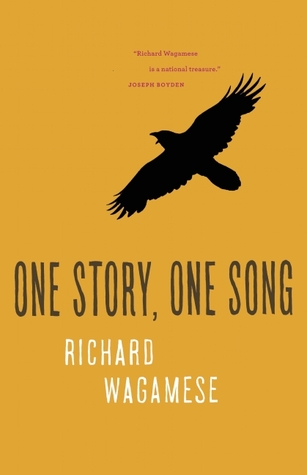
One Story, One SongAnd the third time around the circle, Sharon shared a story about a crow who wanted to be an eagle, from aboriginal author Richard Wagamese's book, One Story, One Song (2011, Douglas & MacIntyre, ISBN 1553665060). It spoke to all of us in different ways, and we expressed how the story fit with our lives. Then Sharon closed the circle with one more prayer, and we said our farewells and headed home through the snowy afternoon.

To experience a sharing circle with complete strangers made me see how Dave Chief's words about it having healing power and creating unity is absolutely true. Each person listened respectfully to everyone else, and though we came from diverse backgrounds as people of Aboriginal and settler heritage, the stories told and the tears that flowed bound us together in friendship in two short hours.

I am someone who is quite aware of the privilege I've grown up with, so I was a little apprehensive about how a circle would actually work. But it did work because no one blamed or judged anyone else, everyone was respected, and deep truths were spoken. We were all invited to share, we all listened, and we all came away with a deeper appreciation for each other's lived experience.

I'm not sure if Talking Circles are part of the Truth and Reconciliation Commission's 94 Calls to Action, but I really hope so. I'll have to read them to find out. Regardless, reconciliation requires sharing of life, deep listening to the struggles, hurts and joys of others, and a respect that leads to friendship. At our women's talking circle, we got a preview of what healing our nation, learning from Aboriginal people, and healing settler biases and prejudices could look like.

Hope for healing Canada comes through forgiveness, friendship, and community. If you ever have the opportunity to attend a talking circle, I'd highly recommend it.

And I think Richard Wagamese's book will be worth a read, too -- I'm going to borrow Christina's copy!