Showing posts with label St. Francis of Assisi. Show all posts

Sunday, October 29, 2023

Sunday Reflection: Two great commandments

Today's reflection is brought to you by 
Matthew 22:37-39. 
A statue from Gubbio
(wish I knew the artist's name)

Jesus told him, "You shall love the Lord your God with all your heart, and with all your soul, and with all your mind." This is the greatest and first commandment. And a second is like it: "You shall love your neighbour as yourself." 

I offered the following reflection to the people of the Community of Emmanuel in Edmonton's inner-city this morning. They listened very attentively -- who can resist stories about saints, whether they be the capital or small S variety?

Today in our reading, Jesus gives us what he knows are the two most important commandments, and
these commandments leave us with two questions: 

First of all, how do we love God with all our heart, soul and mind? What does that actually look like?

And secondly, how do we love our neighbours as ourselves? What does that actually look like? 

When I was thinking about this reading and what I might say about it, I also realized that this coming week, Tuesday, an interesting annual celebration will take place. Have you thought about it at all? Halloween is coming. Besides being a day of weird, deathly celebration, costumes, candy, and tricks or treats, it’s really the evening before the great spiritual celebrations of All Saints and All Souls’ days. And if we want to love God, who better to show us how than the holy saints and souls from ancient times and our own personal histories? They give us many examples of how to love Creator and do as Creator asks. 

So what are saints? In our time, it's easy to think of people like Mother Teresa when we think of holy people. She was amazing in her life and commitment to caring for people in Calcutta, India, and she started a group of missionary people who live and work all over the world now, helping wherever they can. But you and I aren’t likely to be Missionaries of Charity or Mother Teresa kind of people… or are we? 

I've always liked the story about the little kid who visits a big fancy church with his grandma during summer holidays. He's never been in a church like it, and he’s asking her lots of questions. “Who are all these people in the colourful windows?” he asks. And she replies, “They’re saints.” And she tells him a few stories about the saints in the windows close to where they are sitting.

Sometime later, back at school, the word "saint" is on his spelling test, and his teacher asks the question, “What is a saint?” and the little boy says, “I know, I know! A saint is a person the light shines through!” 

And that’s a pretty cool definition of what it means to be a saint, if you ask me, because we can all be people that Creator’s light shines through. By being kind to someone, sharing what we have, giving help wherever we can, we are letting God’s light shine through us. When I meet people at the door on Sunday mornings, sometimes I’m blinded by the light of a smile, or the kindness that someone shows to someone else. Our coffee ladies let the light shine through, don’t they? And our volunteers who bring the lunches? They are being signs of God’s love. God’s love and light shine through the way they care for all of us here at the Community of Emmanuel! They are saints, aren't they? 

We’re all meant to be saints – we already are what I call small s saints, or good people trying to be even better, though there aren’t stained glass windows with our pictures in them! And we all know saints from our own lives, people who let Creator's light shine through them in their love for us. I’d like to give you a quiet moment to think about someone in your life, past or present, who is or was a sign of God’s love for you. 

(Brief pause.)

Did you think of someone? Maybe more than one person? I thought of my Grandma Dorothea, my dad's mom. She wasn’t perfect, she had a temper, but she was also a lot of fun. I remember her turning cartwheels on the front lawn when I was a kid. I couldn't turn a cartwheel to save my life, but Grandma could. She taught me to cook some foods traditional to my family, clobbered me in cribbage and rummy, made the best gingersnaps, and could yodel like you’ve never heard at our family sing-alongs.

Eventually Grandma became disabled because of arthritis, and I remember visiting her in the senior's home in Saskatoon. I would peek in her door to find her in her wheelchair, holding her almost worn-out prayer book in her hands, praying for her family. And when I would say, "Hi, Grandma!" her smile was the kind of smile God would have. Absolute delight and unconditional love! I hope we all know someone who is radiant with that kind of love for us. 

Those kind of people are small s saints, as are we, on our journey to Creator. And then there are the capital S saints – the people you see in the stained-glass windows. Maybe you’ve heard of my favourite, Francis of Assisi. He was a rich young man who was supposed to inherit his father’s textile business, but he noticed that, compared to the people who worked in his father’s factories, he was living a life of luxury, and that wasn't fair! He decided to take sides with the folks who had less, just like Jesus asks us all to do, and he walked away from all that luxury to live simply, like Jesus did. 

Many of the priests and bishops in the time of Francis were more interested in power and money than in caring for their people, so Francis started a community of Little Brothers to care for those who were down on their luck, sick, disabled, or elderly. Of course, the Francis and his brothers put the rich priests and bishops to shame, and created a bit of an uproar in the Church. Jesus would have been proud!

Francis also loved nature, and is the saint of ecology, of living in harmony with creation. There are many stories of him preaching to the animals. Not far from where I live, there’s a statue of him talking to the Wolf of Gubbio. The wolf was causing many problems for the people of the town of Gubbio, killing their livestock, and eventually, killing even the people who tried to kill it. The people of Gubbio were terrified. 

Francis was living in Gubbio at the time, and decided to do something about it. He went out of the town's fortified walls to meet the wolf empty-handed, saying, "Brother Wolf, I come in peace." The wolf charged at Francis, but soon realized that Francis was different -- he had no sticks or clubs or knives to threaten the wolf. So the wolf circled Francis, who said, "Brother Wolf, you are hungry and afraid, and you are doing what wolves do to feed and protect yourself." Then he turned to the people and said, "And you are worried and afraid, and you are doing what people do to protect themselves and their livestock." 

Francis soon set up a pact between the wolf and the people – that the wolf would be gentle and kind if the people would take turns feeding it -- and the wolf lived in peace with people for the rest of its life.

It's a beautiful story, an example for us to follow. We all have wolves in our lives in the form of difficult people or situations. The story of Saint Francis and the wolf of Gubbio is a lesson about how to relate to those who don’t view life the way we do -- through understanding and compromise. Francis' life is full of stories that help us to see how we can be better people. Saints like Francis are people who let the light shine through themselves, and help others let their light shine, too. 

So that was a long detour when it comes to Jesus’ great commandments, but it’s leading me back to the first question I asked -- how do we love God with all our heart, soul and mind? What does that look like? Well, we have the example of compassionate and loving people around us – in our own lives, and in the past. Small s and capital S saints. We see the light shine through them, and their example encourages us to let God’s light shine through us too. When I am able to let Creator’s light shine through me, I am loving God with all my heart, soul and mind. 

But letting God’s light shine through us isn’t always easy, as we see in the second question -- How do we love our neighbours as ourselves? What does that actually look like? 

I’m going to break this question in half and focus on the second half first. Before we love our neighbours, how do we love ourselves? Do we even recognize ourselves as loveable? Or do we get hung up on our unlovable qualities? 

We need to remember that Creator is not hung up on the things we think are wrong about ourselves, the negative things people have said to us that stick with us and make us feel bad about ourselves. It's too easy to get down on ourselves when people aren't kind to us, or step on our natural way of being. 

I'm one of those people who can be overly enthusiastic, jumping into conversations, interrupting other people's chains of thought... and when people react to that, sometimes I feel like I should just shut up and never say anything again. But playing small is not serving Creator, who needs someone with enthusiasm to jump in some of the time. I just need to learn to curb my enthusiasm to let other people shine too. 

It's easy to get down on ourselves, but do we realize that it's important to believe that Creator made us the way we are on purpose -- and loves us every day? Because Creator does love us, no matter what. Think about this – Creator loves you so much that there’s this incredible planet for you to live on, given to you for free. Creator made entire diamond galaxies out in space to sparkle and shine just for you to see. Creator woos you with gorgeous sunrises and sunsets and gives you moments of beauty, goodness, and truth if you look for them. Creator made human love to show you the overarching love behind everything that exists, from the tiniest grain of sand to the highest mountain, from the tiniest little bug to the most enormous blue whale, from the depths of the sea to the depths of your heart. And nothing you can do can stop that love. It just is. For you! 

So if Creator loves you that much, can you love yourself that much too? Because that’s the kind of love Jesus is saying that we also need to extend to our neighbours. Even when our neighbours are unlovable. Sometimes they can be like the Wolf of Gubbio, challenging us in ways we'd rather not be challenged. It’s not easy to love ourselves or our neighbours sometimes, but I’d like to guide you through a little prayer experience that might help with that. 

Close your eyes or focus them softly on something near you. Settle into your breathing for a moment and take these words into your heart. 

 Creator loves me, just as I am. 
 Creator loves me, just as I am. 
 Creator loves me, just as I am. 

Now I invite you to think of someone you love as I go through this prayer. 

 I ask Creator’s blessings on this person who I love. 
 I ask Creator to watch over this person and keep them safe and well. 
 I ask Creator to let the sun shine warmly on this person. 
 I ask Creator to be gracious and kind to this person. 
 I ask Creator to give this person peace and joy. 

Now think of someone in your life who is hard to love. 

 I ask Creator’s blessings on this person who is hard for me to love. 
 I ask Creator to watch over this person and keep them safe and well. 
 I ask Creator to let the sun shine warmly on this person. 
 I ask Creator to be gracious and kind to this person. 
 I ask Creator to give this person peace and joy. 

Now let's pray this prayer for ourselves. 

 I ask Creator’s blessings on me. 
 I ask Creator to watch over me and keep me safe and well. 
 I ask Creator to let the sun shine warmly on me. 
 I ask Creator to be gracious and kind to me. 
 I ask Creator to give me peace and joy. 

Creator, help us to love you with all our hearts, minds and souls, to love our neighbours, and to love ourselves. 

+Amen.

St. Francis and the Wolf
north of Newman Theological College

Thursday, October 4, 2018

The Patron Saint of simplicity

A little pocket-sized gift
from my daughter -- from
www.JenNortonArtStudio.com
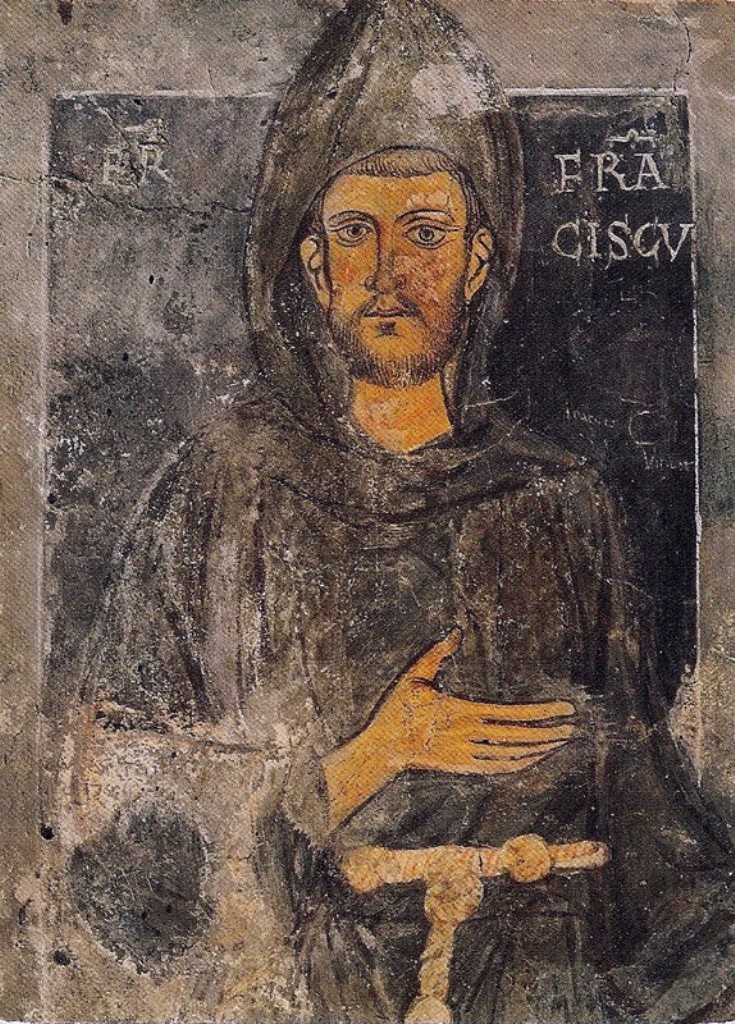
Today is the Feast Day of my favourite Saint, Francis of Assisi, from whom our present Pope takes his name. I fell in love with Saint Francis when I was a kid, and have read about him at every opportunity. Followers of these moodlings might notice that I write about him at every opportunity as well. He's one of the main inspirations for all the work I did with Laudato Si Reflections a few years back. As there's not a lot more I can add, today I'm looking back at past moodlings about Francesco, and listing them here for any interested readers. He makes me happy because he points us to what's really important in life -- loving the marginalized, caring for creation, and following Christ. May he bless your day as well!

St. Francis, the Patron saint of Simplicity
Walking with St. Francis, the earthiest Saint
Laudato Si: Sunday Reflection #1
Celebrating the original Francis
Simple Suggestion #139... Count your squares
Book Review: The Passionate Troubadour
God and St. Francis talk about lawns

Wednesday, October 4, 2017

Walking with St. Francis, the earthiest saint

Image result for St. Francis
image borrowed from Wikipedia
Today is the day the world celebrates a little Italian guy who lived over eight hundred years ago and who really appreciated life, love and beauty in all forms. Francis of Assisi was born into material wealth but saw beyond it to the things that are really valuable -- compassion, openness, the beauty of creation, the importance of living in harmony with nature, the value of those on the margins of society, and the power of simple living. He disregarded the church authorities of the day (who were on the wrong track in many ways) and invited a group of his friends to join him in following Jesus in a radical way, living with the poor and sharing everything that came his way. He was probably the first (only?) Christian to befriend Muslims in the age of the Crusades, and he understood that really, we can own nothing -- all that we have is gift from God.

It gives me no end of joy that there are still many Franciscans and other people of all stripes who follow in Francesco's footsteps today. The present Pope was inspired to take Francis as his name, and what a beloved man he has become even for people who have nothing to do with the Catholic church. Pope Francis is down-to-earth rather than in the usual churchy ivory tower, and offers our world a necessary alternative to the cult of celebrity and consumerism at a time when we really need alternatives! His common-sense approach to life is refreshing after so many church leaders who have been stuck in theological dogma and doctrine to the detriment of really understanding human beings.

If you've followed my moodlings for a while, you already know that St. Francis gets a lot of mention here. I've always felt a deep kinship with him. Today, as I walk the dog, I'll exercise my imagination and invite Francis to walk beside me. We'll discuss the state of our world and what we should be doing about it, laugh at how Shadow-dog imagines he might jump up a tree to catch a magpie, and just appreciate the beauty of a crisp autumn morning. And maybe my side of the conversation will be like the prayer below:

Holy Francis,
please pray with me.
I grieve the struggles
of those who have lost loved ones and livelihoods
to earthquakes and climate change
and human made tragedies of outrageous proportions.
Help us all to find ways to help each other.

Lover of creation,
please pray with me.
I am mourning the loss of life and good portions of earth's abundance
where wildfires, floods, hurricanes and other climate disasters
have killed and
destroyed beauty and goodness.
Remind us all how to live in harmony with nature.

Channel of God's peace,
please pray with me.
I lament the escalation of war and war-like behaviour
in so many people and places in our world.
Help us all to learn your lessons
about sowing love rather than hatred,
forgiveness where there is anger,
hope where there is despair,
and light where there is darkness.

Saint Francis,
please pray with me.
Help us all to be like you --
to welcome those on the fringes,
to follow wisdom and share with others,
to care for creation,
and to offer inclusion and love to all.

+Amen.

Happy St. Francis Day!

Sunday, August 9, 2015

Laudato Si: Sunday reflection #3... Becoming ecology-minded

Cameron Lake, near Waterton, Alberta
Do you remember a time when our earth's beauty bowled you over? When nature left you exultant, and/or speechless?

I suspect that St. Francis, after he became aware of his littleness in creation, spent much of his life in awareness of the incredible world God made and its many creatures (his Canticle of the Sun is just one example of his delight). And I'm guessing that Ecumenical Patriarch Bartholomew is cut from the same cloth.

Today I'm moodling about paragraphs 7-12 of Laudato Si: On Care for Our Common Home, which can be accessed by clicking here. Pope Francis' latest encyclical letter includes both Patriarch Bartholomew and St. Francis in its introduction.

I hadn't run into Patriarch Bartholomew until reading Laudato Si, but what I read in paragraphs 8 and 9 makes me think he's probably an unheralded wise man who has a lot to tell us. He's the bishop of Constantinople, and as such, is considered the humble leader of the world's 300 million Orthodox Christians. He speaks strongly about humanity's actions against creation: "For human beings... to destroy the biological diversity of God's creation; for human beings to degrade the integrity of the earth by causing changes in its climate, by stripping the earth of its natural forests or destroying its wetlands; for human beings to contaminate the earth's waters, its land, its air, and its life -- these are sins."

But being one of those people who likes to take a positive approach to dealing with issues, I prefer it when he uses powerful words to call us to change by replacing "consumption with sacrifice, greed with generosity, wastefulness with a spirit of sharing, an asceticism which "entails learning to give and not simply to give up... a way of loving, of moving gradually away from what I want to what God's world needs. It is liberation from fear, greed, and compulsion."" (paragraph 9)

Bartholomew's words fit with how St. Francis actually lived. I've gone on at length about St. Francis in several of my moodlings (click here to read one of my first posts about him). He's my favourite saint because I think he really understood and lived the way Jesus invites us all to live -- humbly, lovingly, and in harmony with creation. When the present pope was elected and it was announced to the multitudes in St. Peter's Square and over media across the globe that he had chosen the name Francis, I cried tears of joy because anyone who would model himself after Francis of Assisi would be following the direction that Jesus intended us to go before we started using our brains instead of our hearts, distracting ourselves from the love of God and neighbour with arguments over heady doctrines and dogmas.

Looking to St. Francis and Bartholomew for examples is easy. I only wish the encyclical also included wise words from the likes of Thich Nhat Hanh or the Dalai Lama. I can easily imagine them, along with St. Francis and Patriarch Bartholomew, heads together, nodding in agreement over the peaceful and prayerful directions humanity needs to take to save the earth. Who was it who said, "Life is fragile -- handle with prayer"? To that, they would add, handle with justice, with compassion, with respect and love for all creatures...

These are the kinds of people (along with many women who have focused on Creation Spirituality) who really show humanity the way when it comes to living within and loving creation, but they get pretty short shrift in our media these days. Of course, people in Assisi thought Francis was a bit off his rocker because he preached to the birds and the flowers and called inanimate things his brothers and sisters. But he was really the wisest of fools, because rather than taking things for granted as we tend to do in this new millennium, he insisted on treating all of creation as utterly important, not just human beings, and most especially the lowliest of the lowly. (Our media this week spent time on the break-up of Kermit and Miss Piggy. Even in a slow news week, aren't there more important things?)

I'd like to positively paraphrase the last ideas of paragraph 11 because I can imagine St. Francis using words like this, too: If we approach nature and the environment with openness, awe and wonder, if we speak the language of community and beauty in our relationship with the world, if we feel intimately united with all that exists, then care will well up spontaneously, and we will never turn reality into an object simply to be used and controlled. And that's how the world becomes a joyful mystery to be contemplated with gladness and praise instead of a problem to be solved.

Of course, simple positive thinking isn't enough to solve all our problems, to make humanity ecology-minded and turn us from our present course of destruction. The positive thinking has to be translated into action. The challenge is to stop acting as masters, consumers and ruthless exploiters of the earth, trying to satisfy our limitless wants through taking everything.

So today... I want to put on my ecological mind. It's time to look around my life a little. Where am I overdoing it with my consumption of the earth's resources? Where am I failing to appreciate creation? Where do I need to care more and exploit less? It could be something as simple as remembering to turn off a light, or compost an apple core. To avoid buying something I don't need. To think less of myself, whose needs are satisfied, and offer my resources to do more for those whose basic needs aren't being met.

The point is to start thinking like St. Francis, who followed closer in Christ's steps than most of us ever will. Let's consider how we are using (or abusing?) our water, air, earth, and the lives of other creatures with whom we share our world.

It's just a small start back towards the speechless wonder we need to cultivate as members of God's creation. And making it a daily habit to be aware of our consumption of resources and to pray for our earth might also help us to restore the balance it has lost on our account. That's what I am committing to today:

All-powerful God, you are present in the whole universe
and in the smallest of your creatures.
You embrace with your tenderness all that exists.
Pour out upon us the power of your love,
that we may protect life and beauty.
Fill us with peace, that we may live
as brothers and sisters, harming no one.
O God of the poor,
help us to rescue the abandoned and forgotten of this earth,
so precious in your eyes.
Bring healing to our lives,
that we may protect the world and not prey on it,
that we may sow beauty, not pollution and destruction.
Touch the hearts
of those who look only for gain
at the expense of the poor and the earth.
Teach us to discover the worth of each thing,
to be filled with awe and contemplation,
to recognize that we are profoundly united
with every creature
as we journey towards your infinite light.
We thank you for being with us each day.
Encourage us, we pray, in our struggle
for justice, love and peace.

+AMEN.

(A prayer for our earth and all quotations from Laudato Si: On Care for Our Common Home © Libreria Editrice Vaticana)

Next up: #4... The immense and urgent challenge

Thursday, April 19, 2012

Book review: The Passionate Troubadour

Here I go again, on about Saint Francis, but if you've been reading here much, you know that I have a deep fondness for him. He's the patron saint of simplicity, ecology and animals, which partly explains that fondness. He also has a certain appeal for those of us who believe and want to live Christ's teachings in spite of the many distractions we find in our churches.

The Passionate Troubadour: A Medieval Novel about Francis of Assisi: Hays, Edward M.I may sound like a heretic with that last statement, but if so, I'm in very good company -- that of St. Francis. Edward Hays' The Passionate Troubadour:A Medieval Novel about Francis of Assisi (Ave Maria Press 2004, ISBN 0939516-69-1) is the story of a very human saint who faced some of the same sorts of struggles we do today, and who simply strove to love God through them all. While Hays' writing has been described as "wild, poetic and imaginative", I found that once I got past his whimsical style, his version of the life of Francis was wonderful. It's true that the author took a few liberties and created a few characters that are not found in traditional historical accounts of the life of St. Francis, but as a writer myself, I don't fault Hays for giving Francis a wise hermit spiritual director named Padre Antonio, or a Muslim friend named Ali. For those like Francis who want to faithfully travel a deeply spiritual path, it's always good to have a guide for the journey, and for Francis to overcome his era's hatred of Muslims, a soul-deep friendship with a Sufi fits the story really well. Hays does a wonderful job of capturing how an ordinary human being could become one of the most beloved saints of all time. It's a long book (638 pages) but I didn't want it to end.

I read The Passionate Troubadour during the last weeks of Lent and Holy Week, and found it to be a moving meditation on what it means to follow Jesus without the usual "trappings." Francesco Bernardone started out as an ordinary kid, the son of a wealthy cloth merchant. He was expected to follow in his father's footsteps, except... as time went on, his father's obsession with wealth and prestige began to ring hollow. Being a dutiful son, Francesco went off to fight in a skirmish with neighbouring city-state Perugia, and spent a year in captivity in a Perugian dungeon, where he had a lot of time to think about life. He came home a different person, dramatically renounced his inheritance, and became one of the minores, or small ones, in his society. Living with only basic necessities, working for his food, and preaching about God's love rather than fixating on hell and damnation, Francesco moved thousands of others to join the Friars Minor and associated communities by the time of his death in 1226.

Hays does a marvelous job of capturing the medieval mindset within his story -- for example, back in Francesco's day, the world was flat and the Pope was more like an emperor. The author sheds a lot of light on the13th century understanding of sin and salvation and the superstitious practices around both, making for a very interesting read. But what really touched me was Francesco's desire to do God's will in the simplest way... and how often he was stymied by people who made everything more complicated. Love God, love and serve others, and love yourself. Consider the lilies. And if you believe in a God who loves us all into heaven, how can you go around in gloom, even if things are wonky in this world? In this book, Francesco is a joyous, fun-loving man even in his struggles, with a heart for the poor and small. His passion for God and simplicity created and continues to create new life for many people... including me.

If you've been following my moodlings at all, you'll know that I've been struggling mightily with recent changes in my church... and many happenings that seem to indicate that Catholicism is moving backwards rather than forwards, over-complicating the simple basics of Christ's teachings. To my mind, recent fancier prayer wordings that put distance between us and God and seem to emphasize our sinfulness are not as critical as understanding and acting upon the fact that every being on the planet is beloved by God and should be treated as such. Emphasis on maintaining the structure of the Church seems to have overtaken the importance of making our relationship with God a real, living thing that cares for our planet, and seeks out the poor and makes them the heart of our hearts -- and because of that off- kilter emphasis, I'm afraid my love for the Church has taken a serious beating.

In my reading of The Passionate Troubadour, I came to see that Francesco also struggled with the Church and its many imperfections. He lived through a Lateran Council's changes and challenges, and still managed to remain within the Church as a faithful follower of Jesus. He didn't let church politics destroy his sense of community or sour his relationship with God. With God's grace, he was able to let go of his frustrations, acknowledge the imperfections in himself and others, and keep his relationship with God in focus right to the end.

That's what I aim to do, too... though it is anything but easy. My pride makes it impossible to swallow the injustices I perceive within Catholicism, and I admittedly shoot my mouth off frequently. So often I am tempted to simply walk away from a church that ignores women, makes priesthood more important than humanhood, and lives in its head rather than with the poor in the heart of Christ. But Francesco didn't quit. He continued to follow Christ's teachings in a radical way, speaking his mind to sympathizers within the Church, and eventually his example brought about some healthy change. Had he walked away, he would have vanished from the face of the earth without anyone knowing the difference, and our world -- and the Church -- would be much the worse for it.

Francis of Assisi is one of a very few people who took Christ's message to heart and lived it deeply in the midst of a society -- and a church -- that often didn't get it. I expect Edward Hays wrote a novel about him to encourage us all to do the same -- to follow Francesco by preaching the Good News of God's love with our lives. If you can get your hands on a copy of The Passionate Troubadour (an inter-library loan worked for me), I'd highly recommend it.

Tuesday, October 4, 2011

St. Francis, the patron saint of Simplicity

Put on your best Italian accent, and see if you can pronounce these beautiful words:
Laudato si, mi' Signore cum tucte le Tue creature,
spetialmente messor lo frate Sole,
lo qual è iorno, et allumini noi per lui.
Et ellu è bellu e radiante cum grande splendore:
de Te, Altissimo, porta significatione.
I know, it's a mouthful, but a really beautiful mouthful, sung to God in praise for Brother Sun. It's a small piece of Il Cantico del Sole, The Canticle of the Sun, also known as The Canticle of the Creatures, which refers to all of creation as our sisters and brothers (click the highlighted text to see an Italian Wikipedia page with the rest of those beautiful words!) 

Il Cantico was written in the twelfth century by my favourite saint, a fellow named Francis of Assisi. I'll post the translation of the entire Cantico (song) at the bottom of this moodling. It's one that I stumbled across while in university, and kept on my bulletin board to remind me that I am a small sister in a grand creation.

St. Francis was one of my favourite people in those days, and still is. Son of a wealthy fabric merchant and due to inherit the family business, he opted instead for a life of simplicity with a capital S, caring for the poor and living in harmony with creation. His lifestyle was so unlike that of his friends (who thought at first that he'd lost his mind) that they became curious... and when they discovered the joy with which he was living, they joined him, and became the first band of merry Franciscans.

And there are still merry Franciscans with us today. I know a few personally, and enjoy them immensely, as they're anything but stuffy clergy. I walked with one during the Downtown Way of the Cross one Easter, and when something I said struck Dave funny, he laughed so loudly that other participants gave us a look. My Franciscan friends take so much joy in life. If only I could say the same of all religious!

St. Francis had a special rapport with animals, so my neighbour, friend, and local Anglican priest, Dan, holds a liturgy to bless pets on the Sunday before the feast of St. Francis. I love to hear about that kind of thing, because I think that religion as a whole has missed the boat if it says that animals don't have souls. How can anyone be sure? All I know is that creation is good, and if we lived as if every living creature was as important as human beings are, our world would probably be in much better shape than it is.

Francis has been called the Saint of Ecology, and I posted a pretty cute story in that vein about God and St. Francis last year. Unfortunately, all that many people know about him is that his lyrics were sung at Princess Diana's funeral. Several of his poems and prayers have been turned into beautiful music, and way back when, Franco Zeffirelli made a movie about him called Brother Sun, Sister Moon. If you've never seen it, I'd recommend it -- with the suggestion that Francis probably wasn't quite as ethereal as the lead actor portrays him.

I'll leave you with one of the songs that's been made from his words (lovely photos; kudos to the person who put the video together!), and the rest of the words of the Canticle of the Sun. Happy St. Francis' Day! And happy feast day to my Franciscan friends!


Most High, all-powerful, all-good Lord,
All praise is Yours, all glory, honor and blessings.

To you alone, Most High, do they belong;
 no mortal lips are worthy to pronounce Your Name.

We praise You, Lord, for all Your creatures,
especially for Brother Sun,
who is the day through whom You give us light.
And he is beautiful and radiant with great splendor,
of You Most High, he bears your likeness.

We praise You, Lord, for Sister Moon and the stars,
in the heavens you have made them bright, precious and fair.

We praise You, Lord, for Brothers Wind and Air,
 fair and stormy, all weather's moods,
by which You cherish all that You have made.

We praise You, Lord, for Sister Water,
so useful, humble, precious and pure.

We praise You, Lord, for Brother Fire,
through whom You light the night.
 He is beautiful, playful, robust, and strong.

We praise You, Lord, for Sister Earth,
 who sustains us
with her fruits, colored flowers, and herbs.

We praise You, Lord, for those who pardon,
who for love of You bear sickness and trial.
Blessed are those who endure in peace,
by You Most High, they will be crowned.

We praise You, Lord, for Sister Death,
from whom no-one living can escape.
Woe to those who die in their sins!
Blessed are those that She finds doing Your Will.
No second death can do them harm.  

We praise and bless You, Lord, and give You thanks,
and serve You in all humility.